Monday, 30 April 2012

Kevin Roberts. And The Saatchi + Saatchi scandal.


Kevin Roberts is really causing a stir.

He's 63 from Lancaster and has amazingly come up the ladder. A brand manager at Mary Quant, to international new products manager at Gillette, to Group Marketing manager at P&G, to regional VP at Pepsi and since 1997, worldwide global CEO of Saatchis. Not bad. His blog is here http://www.krconnect.blogspot.com/

Saatchis of course, are the quintessential traditional Ad Agency, a space I know very well indeed, having grown up with it (my Dad was at Saatchis and my Mum was at CDP).

I also know it very well having spent a lifetime as owner/CEO of Irish Ad agencies, some big (McConnell's/Lowe 88 million euro turnover was the number 1 agency here), and some small (AFA advertising had 7 employees when I started there 30 years ago). 

But I was steeped in it from the breakfast table and also having served 2 terms as President of The Institute of Advertising Practitioners (and later a Fellow) and as Chairman as The Advertising Press Club (and later a Fellow of the Marketing Institute). It matters not, except to give some more credibility for Kevin's position.

I'm friendly with the CEO's of most, if not all Irish agencies currently. When the Kevin Roberts story came out, the emails between us got hot.

Whilst I have been a traditional ad man all my life I have also been involved in the digital space for 15 years and am very enthused by it. Evangelistically so. The Kevin Roberts piece for me, was waiting to happen and hugely welcomed, because now I had something to point at and say, look don't listen to me, listen to Kevin. And so now had they, which is what they didn't want.

What he's saying is, as the header on this blog says, the world just changed. Here's an extract from The Drum;


During his colourful presentation, which followed on from a speech from Deputy Prime Minister Nick Clegg, Roberts said: “I am a radical optimist, I don’t buy into all this recession talk. I do not think we are in a recessionary environment, but we do have too many recessionary leaders. To win today we all need to power things up and speed things up.


“We don’t just live in a VUCA world - a volatile, uncertain, ambiguous and complex world - we live in a super VUCA world. We live in a vibrant world where our kids are connecting to each other and to brands across the world with no money involved. To us this is a world that’s gone crazy.


“Strategy is dead. Who really knows that is going to happen anymore in this super VUCA world? The more time and money you spend devising strategies the more time you are giving you rivals to start eating your lunch.


“Management is dead. To win today you need a culture and an environment where the unreasonable power of creativity thrives. Ideas are today’s currency not strategy. Martin Luther King did not say ‘I have a vision statement’ did he? He had a dream. You have to make sure you have dreams and your brand also needs a dream.”


He went on to outline how successful business leaders need to harness creative thinking in the future, saying: “Business leaders need to become creative leaders. We need to change the language of business. Who wants to be a Chief Executive Officer? It sounds like you work for the government and who would want that? Being a Chief Excitement Officer would be better, don’t you think? The role of a good CEO is to get people to buy into their dreams and their company’s dreams.”


Roberts also went on to say that the age of the ‘big idea’ has gone.


“The big idea is dead. There are no more big ideas. Creative leaders should go for getting lots and lots of small ideas out there. Stop beating yourself up searching for the one big idea. Get lots of ideas out there and then let the people you interact with feed those ideas and they will make it big.”


“Leaders need to become emotional thinkers. The difference between rational thinking and emotional thinking is that rational thinking leads to conclusions and meetings and more meetings. Emotional thinking leads to action.”


“There are three secrets to emotional thinking – mystery, sensitivity and intimacy. It is a lot about story telling. Brands need to tell stories on their websites, on their packaging and so on. Make sure your brand and company has a smell, it has a sound, it has a feel and an intimacy with people. Think about how you can build empathy. It is the small things that count and how consumers feel about our brands that count today.”


“Marketing is dead. The role of marketing has changed now. There is nothing new anymore. If marketers are just hearing about something going on then it is already old in today’s world. The further up in a company you go the stupider you become and the further away from new things. Speed and velocity is everything today. Marketing’s jobs is to create movement and inspire people to join you.


“Everyone wants a conversation. They want inspiration. Inspire people with your website. Don’t just interrupt, but interact. Asking about Return on Investment is the wrong question today. You should be asking about Return on Involvement.” 

He's saying strategy is dead (because we can't control brands anymore) and he's saying traditional advertising as we know it, is dead. I'll add to that, brands and brand loyalty is dead.

Kevin as the worldwide CEO is saying something which, for other Agencies, is heresy. It's like an earthquake with some even saying they could see the smoke rise over the city. Ad Agencies have been ultra critical of the web in an ignorant way. They didn't understand it, bothered to even look at it, and just started rubbishing it in the hope it would all go away and we could all get back to press ads. 


Here's one response, for example, by an Ad Agency to Kevin's piece on The Drum.


"Boy, Kevin is "down with the kids", isn't he? Although I have to say he isn't boring. And he understands PR.


‘Strategy is dead’: entertaining, but bollocks. Most people can't even define the word (I've actually got a training course on this very subject on my website). This week the government was accused of not having a strategy, by somebody who went on to talk about their “lack of clear aims”. It isn't the same thing. Anyway, it's perfectly possible to have a genuinely-strategic approach to selling your products without falling foul of the errors Kevin suggests.


‘Marketing is dead’: entertaining, but bollocks. A useful definition of marketing is' finding out what people want or might want and selling it to them at a profit’. Most of Kevin's speech consists of advising us all how to best do this, by avoiding things that Everybody Doesn't Want and giving Everybody what Everybody Does Want.


So the very least we have to question the Saatchi CEO’s definition of ‘marketing’.


And here, of course, lies the point of the whole thing. What Kevin would doubtless like clients to believe is that the science, rationality, and thinking part of the selling process is all dead. (And the nasty research, too, ooh, especially that.) All you poor clients can do is turn over your money to companies who will provide you with amazing creative ideas , even if bereft of any consistent direction or scale, so as to attempt to distract the mass of novelty- dazed goldfish allegedly inhabiting the modern marketplace. Coincidentally, raw ideas are pretty much the one currency which the advertising agency, as opposed to a raft of other allied service providers, still holds.


Now I'm not even sure if the points he makes apply to the majority of under-30’s. But let's not forget that the majority of consumers in the current EU marketplace, at least, are middle-aged or older. Go find some statistics for the dropout from things like Twitter within these demographics. Ask yourself if they are really in the market for a constant barrage of unrelated, "new" stuff, out of which they will decode your company’s offer and grow to love you. They aren't. They are in the market for good stuff, well presented. You can still do that strategically, using a lot of traditional marketing thinking"


So now instead of thinking, listening, understanding, they're going to have a patronising go at Kevin. Too bad. They've lost already.


The game is officially lost.

Kevin has just made that final too, because now a large traditional player is saying it publicly. With that level of endorsement, it will become self-fulfilling.


Instead of disdain, we had a chance to treat the web with respect to create a whole new opportunity. Ad Agencies were THE perfectly placed people to control this space for brands and they didn't and they don't.

You can see it even in how little attention they give to their websites alone.

So they will wither on sticks.

This might be last chance saloon for some and Kevin might prime them into action, but I don't think so, I think it's too late. Marketing is dead, Advertising is dead. 


Large traditional Ad Agencies? Dead. 


Kevin understands.


But like the peasants in Lamb's essay, we know not how to roast pork, other than to burn the house down.

Friday, 27 April 2012

Kickstarter. Looking for funding?


We all know funding for everything is tight and funding for tech start-ups is well, even tighter.


However, once you get past GO, not only is cash there but also high valuations as I've talked about before. In fact never a better time really - http://streamabout.blogspot.com/2012/04/social-media-jump-in-cash-in.html


We also know that as start-ups, the difficulty is in getting to meet potential investors whom mostly claim to have investment sanction (when they haven't) and are really looking for a cappuccino to see what you're at. Others dismiss you as "pre revenue" or as "post revenue" - either way it's an excuse for a no.


Then Banks aren't lending, so investment funds associated with banks, already shivering from being "caught before" on loose lending, are looking to bring the reins in.


State grants are small, tiny in fact, but driven around a rigmarole about elevator pitches, 2 minute pitches (it is fun to watch someone squirm isn't it?), online entries for mention at summits (where even you can meet an expert!) and ultimately, a series of neverending hoops in the forms of Business Plans, Cashflows and Forecasts.


Ultimately too, you're faced with the greatest challenge of all. How do I sell an online idea to someone who just doesn't get it?


Crowdfunding therefore is a terrific solution to bypass VC's and the Investor Commissions by getting people like you and me to invest in others projects that we admire. Small money required but hey, you never know, as well as helping someone along.


It cuts out a lot of nonsense.


Kickstarter is probably the most well known crowdfunder of them all - kickstarter.com - and really well worth a look for creative projects. You explain your project, state what you're looking for investment-wise, in what timeframe and if you achieve funding commits of 100%+, you get it. You don't, well, you don't. 99% investment pledges achieved.... and you get nil.


Pebble Smart Watches was one of those.


It's a slim, water & scratch resistant watch with an epaper display visible in daylight. It interfaces with the phone over Bluetooth and can be customised for alerts like email, messages and so on. It will also run Apps to monitor cycling, swimming, running - just like The Nike Fitbrand Apps (try them, they're terrific, free and have done a great marketing job for Nike).


Pebble asked for 100,000 usd investment to get going on Kickstarter from like-minded people just like you and me. In the first 24 hours, they got 1 million usd and today, over 3m usd with a minimum "pledge" or investment of 115 Dollars.


Not only have they well achieved their investment but they've created a market of ordinary "investors" who'll buy the watches and spread the word. An army of sales people.


Funding Circle, a UK based "Kickstarter" targeting small businesses, has raised 21m usd and can give investment "within days", without the cappuccinos and nonsense. There's even Offbeatr which attracts crowdfunders interested in investing in porn projects.


So crowd funding is getting better and getting bigger.


If you're in the start-up space have a look.
It's zero cost but potentially a big upside.


And it's one-in-the-eye for the slow big investors who like to call themselves VC's or Founder Funders. One up for the ordinary bloke with a 100 dollars who actually does some good. And if we all got involved in this space, albeit in a small 100 usd/100 euro way, we could all benefit from that funding.


It's self-fulfilling.


Long live the revolution!

Thursday, 26 April 2012

Netflix. The greatest change in Broadcasting since the birth of TV.


Netflix. You've heard of them, you might be using them, you certainly know all about them.


It's a streaming video service (VOD) on the web which allows unlimited access, on demand, to a large variety of movies and TV series, at a flat rate monthly fee (7 euro a month). 


They're only streamed on all smart devices (Online, Ipad, Iphone, online TV connectors, soon Apple TV and so on) although also with a DVD home business and launched in Ireland late 2011. So you can't watch Netflix obviously, through your normal TV Channels. And that is the real breakthrough.


I think it's fair to say that Netflix's offering is not exactly top line movies but rather old, frankly "second rate" films at the moment. But for kids, a world of Peppa Pig and Dora the Explorer - Ideal for young kids. So it's a low cost family brand. 


Isn't it interesting to note that established brands here such as 'Xtravision' , one-time dominant, have let this business past them. Their response is to re-shape and have now tried to move into more of an "entertainment" offering (buy a DVD, get a Coke, get Popcorn and so on). 


It's another example of web brands killing offline brands because they got there first. I have blogged that a hundred times before and no doubt will do so again.


Watch the way old huge grocery retailers will be swept aside and big telcos lose their shirts. As they pooh-pooh the web, it eats them alive.


I think it's also fair to say that Netflix have achieved their growth with probably owning the worst corporate identity in the world backed by some shockingly poor advertising. Cringeville stuff.


And lastly it's absolutely fair to say, that Netflix will take viewers from TV broadcasters, consequently reducing audiences and de facto, reducing traditional TV advertising. 


Isn't it amazing that no big terrestrial traditional TV broadcaster (except possibly SKY) have even attempted to enter this market when they already have the premium content bought and the production skills? Shocking. 


One response of course, as usual, is a ham-fisted attempt to curtail Netflix through data caps. Ah well, nothing unusual there then.


This week Netflix announced its results and depending on whom you read, they were either received by so-called analysts, "favourably" or "terribly". One highlight however, was the substantial growth achieved in Ireland and the UK following recent launches. Netflix also elaborated on a strategy to improve their library content and generally, supply better movies. To do that, they'll have to compete in a bidding war with traditional broadcasters and particularly the cable networks.


If Netflix get the cash, and they will, it's going to make life harder for TV broadcasters without premium content. As they scratch their backsides.


Equally, and this important, Netflix will focus on generating their own content. In other words, investing in programme making for live streamers like Streamabout (!).


Whilst they added close to 3 million streaming subscribers, they lost 1m of their former DVD users. Not much of a surprise here as people switch to online viewing. Unless you're an analyst. A net loss of 5m in the first quarter is less than was expected but the stock fell.


Netflix estimates an additional 7m subscribers this year (bringing it to 30m) 


When you look at it, this is a business only going one way - up.


A loss of 5m (less than 1%) on revenues of 870m usd in Q1 is incidental and a ridiculous metric to look at for such a new company in growth - and a loss that'll be easily fixed.


Netflix is establishing itself as a brand although content will be king and especially when Amazon's 'Love Film' ratchets up. The product needs to improve but they know that (and that's Step 1).
What's the most important lesson here is not the numbers but the huge shift in customer viewing.


It's rumoured that Netflix already have 200,000 Irish subscribers.


That's 200,000 Irish people who find it acceptable and are prepared to pay, to watch movies on a smart device and not through their dvd player nor on their telly.


That is the greatest sea change in 20 years.


And an Irish audience, although savvy, are conservative, so this is going to go huge globally. 30 million viewers alone this year and think, when you own that amount of viewers with long dwell times on your site, what else can you sell into them? A lot of products and services. It's not just about video, it's about eyeballs.


It mirrors the dramatic growth in streaming too.
Analysts talking about "sell" or "hold" recommendations, should do that and let intelligent people access to the stock. The donkeys of Wall Street.


Because, Ladies and Gentlemen, this is the greatest change in media consumption I've seen since the birth of Television.


End of.

Wednesday, 25 April 2012

Microsoft's Mistake?


I worked in Irish Advertising in an Agency that at one time, was highly regarded. McConnells.


There wasn't a presentation or meeting you went to, without that commercial being played to make a point about brands and marketing (just an aside, did you recognise the voice over? A young Richard Dreyfuss). Looking at numbers last week for Microsoft, it became all the more clearer what it meant. And here's why.


When you grew up in this digital age, like I did, there's no doubt that Microsoft was the star. Gates & Allen stood out as pioneers with a seemingly endless amount of technical products and ideas.


People queued overnight to be first in line for a Windows launch in the Harry Potter way they do today. It was the cool brand.


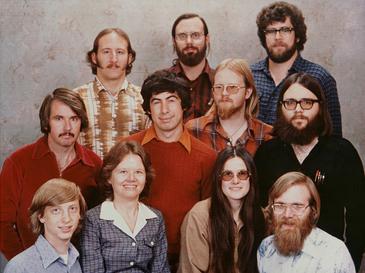
Microsoft started in 1975 (talk about being way before your time) and it had 1m usd in revenue in that year situated in Albuquerque of all places. It was Allen's idea to call it Microsoft by combining Microcomputer and Software.


That's Paul Allen bottom right and Gates bottom left in a staff pic from 78.


It wasn't until 1985 when it was asked to write an operating system for IBM, that things really started to take off. In working with IBM they also continued their own business and to the amazement of the world, Windows 1.0 was launched that year. 


Over time, by owning the operating system, the launch of Windows 95 gave them their first big entry onto the web through bundling their web browser Internet Explorer free, with the operating system. And so became the "browser wars" and the rest, as they say, is history. Ultimately gaining the accolade of 'The Evil Empire'.


Of course, an extraordinary company built by terrific people.


5 years ago, Microsoft reported profits of 6.5 billion usd.
This year they've just reported profits of 6.4 billion usd in the same quarter.


So they're still making money - but making less - although it's still a stunning amount of money.


At the same time 5 years ago, Apple reported profits of 1 billion usd.
This year, Apple reported 13 billion in profit comparably.


What is clear is that Apple has practically wiped out Microsoft as a consumer technology brand with Microsoft now having to focus on its buiness division to bring in the revenue. It has also been played out of the mobile space, where it once controlled 35% of the market.


Apples iphone business alone is bigger than all of Microsofts businesses, combined.


So ask yourself why?
What has caused this change?


It's simple and obvious but so well forgotten - Apple put the consumer first. By identifying the consumer need they then built the technology to satisfy that need.


Not the other way round.
And then be clear about what you stand for and understand your core values.
This video is inspiring and full of lessons for marketeers.


The commercial at the top of this blog is the one which Jobs just referred to in this video. Think different (1997 Chiat Day).


So the story here is clear. 


You think like a consumer.
You think of consumer needs and you fulfil them. 
You do so in a clear easy-to-understand way and you are 100% clear on your proposition. 


Then the marketing job becomes easy.


It's why Apple has wiped the eye of Microsoft.
It's why the next Gates, Allen, Woz, Jobs will do the same.


Building software, hardware, Apps, Blogs, Social sites and all, will only achieve success, if they're meaningfully providing a solution to a real consumer need (which Pinterest is a clear example of how to do that).


We can all learn from Microsoft and Apple.
They got it first.
Think Different but think Customer. First.

Tuesday, 24 April 2012

Social Media. Jump in, cash in.


A little while ago I blogged as to whether we were seeing the signs of a bubble, similar to the one which pre-dated the 2000 crash 
http://streamabout.blogspot.com/2012/04/billion-or-bubble.html

A couple of reasons prompted me to ponder that.


Firstly I was there in March of 2000 with an IPO for an ISP and it just "felt" the same. It had the same "feeling". Hardly science but if it looks like a duck, walks like a duck.....and I'm not the only one feeling that.


Secondly of course, Facebook had just acquired Instagram for a billion which seemed (and seems) to be twice Instagram's own excessive valuation a week previously. And it's a lot of cash even for something as cool as Instagram.


Thirdly, and perhaps most importantly, the Instagram acquisition came from a sucession of quick acquisitions of companies with low revenues, low staff and light track records. This to me marks out a bubble. A high level of investment interest in something that's not sparkling now but which will. Something that has belief.


By quick, I mean that only days before, Mashable, which is a blog (yes, I know it's a really good blog) but a blog nonetheless, had just sold to CNN for 200m usd. Around the same time, Draw Something, an App only weeks old had just sold to Zynga for circa 200m usd. Then most recently, Apple had achieved a valuation (market cap) of 600 billion usd. And so on.


At the same time I was noting on forums for venture Capitalists/Investors that war chests were being built. Money was being raised.


Big news then today from the UK that "Vodafone, one of Europe’s biggest mobile operators, has made a formal offer to buy up the assets of Cable & Wireless Worldwide for £1 billion ($1.7 billion), a deal that catapults Vodafone into running its own fixed line network in the UK and specifically will give it a much bigger view to winning enterprise business — a big challenge to BT and a mark of further consolidation in the space" (Techcrunch). This brings Vodafone over 10 billion usd in revenue and it's an 'agreed' bid.


Another 1.7billion usd deal.
Add to that data based start-up Locu, has raised 4m usd; Moat, an adtech start-up raised 12m usd; Answers.com, who raised 127m usd last year, announced a "significant minority stake"; Tango, a video chat service (not unlike Skype), closed a road of 40m usd in funding.
And that's just this week.
Finally just if you remain unconvinced, we are even starting to see the bragging rights of investors.....Andreesen Horowitz proudly revealing that it made $78 million off its $250,000 seed investment in Instagram’s billion-dollar acquisition (which is pretty unpalatable actually in a recession reeling world).


If this is a bubble, it's one great big opportunity.


It will bring higher valuations and potentially competitive exits. More money for Social Media investment, more money for marketing, more money to engage.


If ever there was a time to get online, develop Social Media ideas, bring new thinking to the Web, it's now.


There's money out there and more of it coming.

Monday, 23 April 2012

Apple, E-Books and the Steve Jobs Secret deal.


"Eroding the value of perception of their products in customer's minds" said Steve Jobs about the Amazon Kindle launch when they began discounting top titles to 9.99 usd. So he went about fixing it and here's the story.

I consume books, I don't just read them, I eat them. Probably three a week and I have a lot, an awful lot, in dust jackets lining shelves. Nearly as many as I now have on my Kindle.


Because I loved books and bookstores, I was one of the first to dislike The Sony EReader when it launched and yet, one of the first to adopt it because I'm in that space. 


Interesting isn't it, that Sony were one of the very first companies to get into book etailing given their ongoing demise as I blogged recently here http://streamabout.blogspot.com/2012/04/sony-64billion-loss-and-death-of-brands.html. They actually had THE opportunity to own this market. 


The principle was the same as itunes. Once you buy the device, you had to log into the service to download and activate. So you automatically were forced to become a book customer by just purchasing the hardware (indeed exactly the same subsequently, as Amazon's Kindle). But it guaranteed the device maker (Sony) revenue from ongoing book sales. The profit was not in the device, it was in the subsequent ecommerce book downloads and indeed, looking back they should have given the device away for free. Like shaving - the real money is in the blades not the razor.


Anyway, the Sony ereader, although first out of the box to market, was poor. Hard to operate, hard to understand, no real "store" with insufficient titles and after a day trying to operate it, I put it aside in a drawer, where it remains today untouched and unused. And then I was given an Amazon Kindle.


Actually when you think about it, Jeff Bezo's Amazon (the world's biggest bookstore) must have looked on at the time of the Sony launch with real concern which probably gave impetus to their first Kindle device. Here was a big player, Sony, entering their online space. So they had to get their device out there quickly and being rushed, did so as a basic model with few features (it's basically a black and white screen and nothing else).


But supported by a bookstore like Amazon, the Kindle quickly moved to push aside everything in its wake and achieved an unbelievable 90% market share and ultimately selling more ebooks than books themselves. 


And mine changed the way I bought books forever - a fantastic little device that I adore to this day.


Recently near where I live (Dalkey, Dublin) a beautiful little book shop closed after 30 years. Run by Michael, I went up on closing day to shake his hand and thank him for the memories - but on reflection of course, us downloaders must take some responsibility for these closures. Ebooks have destroyed retail sellers like 'Waterstones' and the wonderful 'Borders', but mind you, these retailers also let this online business get past them. Exactly as so many brands still are.


The Kindle has also revolutionised price, bringing down the cost of books. The Kindle Fire, in my view, is a further example of Amazon's ambition to sell more than books and notably VOD (movies /video on demand). In reducing prices, through reducing margins (such as retailer margins) it "upset" the market but was good for consumers. 


Publishers had always controlled publishing, pricing and distribution. Now they had a total change on their hands through the Kindle which actually allows authors direct access to publishing/distribution online. Great actually that the internet has broken that stranglehold too. But they didn't like it. And neither did Steve Jobs.


So in walks Apple. Late to the party but with a hugely popular device/s already out there (Iphone, Ipad) which could easily become book ereaders and in turn give Apple access to the market and compete with Kindle under a brand called 'ibooks'.


During that time (2008/9) Apple had meetings with certain publishers - because in order to become a major online book reseller, you need the content, the books, from the publishers. So you need the publishers "onside".


These meetings (actually more dinners than meetings included none other than Steve Jobs himself) took place in swanky restaurants such as New York's 'Picholine' and 'Alto' (per 'The Financial Times') with 5 of what is known as "the big 6" worldwide publishers.


What has been suggested and last week the subject of court filings, is that these meetings were in fact an attempt by Apple to collude with publishers over ebook prices (per 'The Daily Telegraph'). 


Publishers would enter into new agreements, called 'Agency models' with Apple, where the publisher could dictate the price of an ebook, provided the retailer (Apple ibooks) got 30% of the price. Not only would that fix prices, but drive them up for the consumer through collusion. And in doing so, give The Amazon Kindle real (unfair) competition.


Of course Apple gained by having the publishers support (so ibooks now had content) and it gave the publishers, in conjunction with Apple, an opportunity to re-establish old margins which had been squeezed as Amazon forced prices down.


Real greed, real old-world manipulation of Dickens and Thomas Hardy if it's proved to be true.


In three days in January 2010, on the eve of The Ipad launch the 5 publishers signed these "Agency agreements" with Apple (HarperCollins, Schuster, Hachette, Penguin and Pearson).


The charges that have now been filed against Apple and the publishers were immediately denied by Apple who said the "charges were simply not true". Fighting talk, however we then discover 3 of the 5 publishers, whilst admitting no guilt, immediately moved to settle. They claim innocence whilst at the same time make payments as if they were guilty. Interesting concept.


Interesting too that this weekend 'The Daily Telegraph' reports that Apple (remember, "simply not true") has offered to settle the matter in Europe but vowing to "fight on" in the USA. The European Union had opened an investigation into anti-competitive behaviour by Apple last December. 


In fact Apple now is trying to turn the PR towards the fact they they were simply trying to "break", Amazon's "monopolistic grip". Indeed they were.....by what is alleged, collusion in their own interest and to the harm of consumers by increasing prices.


The fact remains that through their cries of innocence, they're trying to settle matters, as are their collusion publishers, for using price fixing as a way to further their business to the detriment of readers like me. And I hate to say that because I always thought of them as being great.


People often say and are interested in the future of Apple after Steve Jobs and wonder how it will be? They often say, such as after the recent IPad launches that "it wouldn't happen if Steve was there". Sad that in this case, he was. 


What a pity that the great reputation of Apple has become tainted in this way. And yet how great it is to see more books being sold than ever, through the advent of ereaders because of low cost and ease of access.


We can thank Amazon and their Kindle for that.
Apple's "Agency Models" would have had the opposite affect.


Go out and get yourself a Kindle.

Friday, 20 April 2012

LinkedIn has a competitor. BranchOut.


I use Linkedin. I like Linkedin. But I'm getting tired of it.


Tired of long lists of updates and little interaction.
Tired of being constantly told about other people joining new groups.
Tired of a lack of interesting posting and usage.


Although there's no doubt, it is THE Business network where you can actually do business and reach out to business customers. Because largely, it's the one most established and not, if I might suggest, because of its excellence in design.


But it has become very closed as a network - introductions are not made easy - and very commercial through constant advertising. It feels very impersonal and quite limited in content. No video "hangouts", no streaming, limited news feeds and just kind of basic functionality. 


So now it has a competitor - BranchOut.


It's something that Businesspeople should be aware of.


BranchOut allows users to see which of their Facebook friends (or their friends) work at specific companies and it doesn't require users to build a network one person at a time. Unlike Linkedin. And I think that's a key because the slow, time-consuming nature of building a Linkedin network, is unhelpful. 


In lots of ways the profile data is similar and with a recruitment section - RecruiterConnect, (which caused Linkedin to block Branchout from using its API), it fulfills all the things that Linkedin does. And more.


With 13 million monthly unique users, BranchOut is getting more popular as a Facebook App, than Pinterest and Skype whilst still being considered a new "start up". And largely due to early adopters in the mobile space, outside of the US.


I think this is important in that there does seem to be an opportunity in the Business network/Social media space to target Linkedin. Which, it seems to me, has lost its way to a degree.


The Business market online, has real growth potential as more and more business people consider online as a place to be. Perhaps too, Linkedin users may feel it's time to move on.


BranchOut is the first of the competitors.

Just in at 230pm as an update from Business Insider. BranchOut raises 25million usd today: http://www.businessinsider.com/hey-linkedin-youd-better-go-buy-branchout-before-facebook-does-2012-4

Wednesday, 18 April 2012

Sony. The 6.4billion loss and the death of brands.

Most of us will remember Sony as the great, quality premium brand of growing up. Clever advertising instilling a real sense of long-lasting, up-to-the-minute products that were a little more expensive but hey, worth every penny. Innovation through The Walkman, Playstation, Bravia, Vaio, Cameras.....

I remember walking into The Sony Store in New York and being mesmerised by the high technology future on display. It wasn't a shop, it was a glimpse into an enthralling future and it became almost a tourist attraction.


And then most of us recently will have seen Sony spend the last 5 years tearing that image down and re-positioned as the general, competitively priced brand. Just the same as everyone else.

Except having developed the persona of "premium", make the mistake of trying to create it more around "value". People knew the brand and it's hard to move from a long-term embedded positioning to something else without losing customers.

Last week Sony flagged a 6.4billion usd annual loss and an axing of 10,000 jobs. It has of course been hammered by Apple and Samsung. It's stock has almost halved in a year.


It also emerged that The Playstation 3 was being sold at a hardware loss in the hope of recouping revenue on the games themselves.


What has happened here is typical of old-world brands. 


They firstly ignore the web, then they actively rubbish it and then the web, takes them apart. 

Look at what itunes has done to HMV which at one time, had that music business in its hands. Look at what Netflix is doing to retailers such as Xtravision and Blockbusters. Look at the way online gaming has hurt the 'Game' chain of stores. Look at what Amazon/E-Books have done to high street book retailing with 'Chapters' and 'Waterstones' a perfect example of that. Look at the former dominance of 'Golden Pages' compared to Google. Look at Smartphone development and what that has done to Nokia (with a company valuation falling from 100 billion to 11 billion, and quickly). What online publishing (Huffington Post a classic example) has done to Press. It goes on and on.


All of these older businesses had the brand values, the trust, had the customer loyalty, had the business knowledge and yet they got stuffed. In a lot of cases too, because they were run by middle-aged men who had/have no comprehension of what is going on. And still don't. Because they believed they were too big to fail.


The internet is the greatest brand-leveller. Its beauty is that it allows young turks with heads full of great ideas to go and eat established brands lunch. Because they've nothing to fear.

And it's not over. Not even nearly.

Recent news last week from Tesco (a brand I worked on) where they're re-shaping by reducing larger stores to focus more online, is yet another sign. Less and less people will be prepared to park in a car park on their free Saturday to do grocery shopping - they'll do it online. Which in turn means the "anchor" tenant of old in a Mall, such as the likes of Tesco, will lose impact and other retailers, whom depend on the high traffic they bring in, will suffer.


What too,is voip going to do to telephony? And are O2 (another brand I worked on) and Vodafone in a place where they're ready with a serious online strategy? Well? Didn't notice it just yet.

They should note that bigger brands have fallen and Sony's losses, typifies it. This is a big lesson.


Brands don't need banner ads. They don't need a Social Media strategy. They need an online plan. 

It starts with that and re-designing your website to make it "e commerce enabled" isn't one. It needs a total radical overhaul of thinking provided by people who know and not by existing management in the main. 


The excellent Sarah Gordon in the Financial Times says it as "Investors in today's technology titans such as Apple, would do well to remember just how easy it is to lose such a reputation".


Otherwise when the hit comes, it will be hard.
Ask Sony.

Tuesday, 17 April 2012

Google Goggles. Apple Fiddles.


'Heads up' glasses have been around for awhile. Ask any kid who ever read a Commando comic or has seen Terminator. Fighter pilots use them with strong visual displays reducing the need to look down into a cockpit.


Now Google have ventured into the make-believe with Google glasses or Google Goggles as they're known. Not only that, it marks a venture for Google out of search, into manufacture, the preserve of companies like Apple.


Apple is the largest company in the world - 600 billion usd market cap - and this is possibly its biggest threat. Laugh you may, but when a network with the power of Google, enters device manufacture, be afraid. Very afraid.


'Mashable' reports a Google source indicating their availability in 2012 as being "unlikely" but the fact is, that similar glasses already exist at retail and therefore they may not be as far fetched as they seem. The Epson range, not so different, already retails at 699 dollars and look more like surgical glasses than fashion wear, but it's a start.


The thinking is that these will have the same functionality of your smartphone and with augmented reality, bring a lot more. So it's a smartphone replacement strategy too in glasses form. As in IPhone.


Voice commands send messages; photos taken literally on the move, are shared instantly; locations via maps with directions on hand; location of friends through geo-location services; music player with video....and so on. 


Indeed, think about gaming live with the glasses on or to augment skills at work (a mechanic looking into an engine for example, can identify things better). So the applications are limitless in one sense.


Of course, Apple are the kingmakers with devices like this. They have the manufacturer edge and the trust in the brands they create but, and it's a big but, they don't have the social network - or even the network. That gives Google a massive advantage.


So why reveal all so early? Remember Steve Jobs sworn to secrecy obsession before every launch?


Google say they wanted to go early to gather feedback. I don't buy that.


Wired (what has happened to that magazine?) indicated that "it was a project rather than a reality" and Mashable "it's still more of a concept than actual project!". So I think this is publicity and perhaps a sign of intent to Apple that Google intend to enter the device space.


Yep, I agree, right now they look awful and it's highly unlikely that in their present format, you'll ever see them. Or the streets will be full of people smiling and talking to themselves.


However, there's a big play here in the form of augmented reality in a new device and glasses, is one new way to deliver content. 


Imagine if this level of technology and content was embedded into your car windscreen on demand, for example? Better than any smartphone.


It's really a 'heads up' on new content delivery systems. Better than any Iphone and Apples foray into content (Apps, itunes) is device driven. Think about it. You have itunes because you had to because you have an Iphone. It started with the delivery system.


Something which other brands like Nokia, LG and others should be concerned about, if they're not already. 


That's what Amazon's Kindle Fire is all about. Starts with Ebooks (their killer app) and now Movies. Shortly telephony.


And that's what the original browser wars (Netscape V Internet Explorer) were about.


If you own the delivery system, you control the content.
If Google own the delivery system using content they already control, this could be world domination. 


And that's no exaggeration.

Monday, 16 April 2012

Avis. We try Harder. Agencies have a future thanks to Google.


If ever there was a copyline, a slogan, that was self-fulfilling, it's 'Avis. We try harder', because having said it, they have to. In other words, by being honest in saying that they're not the biggest, but they wanted to be, they knew they had to do things better from within the company. You can see that in their press treatments here which clearly tell staff and customers that the company expects more.

I was involved in a well-known campaign for Irish Rail, "we're not there yet, but we're getting there" and it fitted into a similar vein. It's a honesty that half the consumers will like, half will laugh at.


And what happens when it works? Do you go with, "Avis. We're number one. We try less hard now"? I dunno.... but it's brave and around since 1962. 


The company was started in 1946 by Warren Avis but the slogan in 1962 brought the company into the superleague and was created by Bill Bernbachs Agency, DDB. Although it was a defining line for DDB also, Bernbach himself is often credited as the writer. He wasn't. It was Paula Green who is featured in these videos. The truly amazing thing of course, is that it's still the slogan, 50 years later exactly.


This campaign with Google, as part of a series which I've blogged on before (for Coke, Alka Seltzer and Volvo) is defining too in that it takes classic campaigns and brings them into the digital space. Makes them "today".


For me the Coke story is the greatest of them all but this is pretty cool too. They all are. Simply they get the creatives back into Google and see what they can do. Here's that brainstorming.


So what comes of all that is the next video although you probably already get the jist. Basically, they've developed an idea around sharing stories, which you create yourself, about Avis. It's nice. Absolutely nice.... but not stunning. Although remarkable interactivity on the software side, which should not go unnoticed, through the self-publishing of stories, however, we've all become so impressed with online that we feel nothing can surprise us!

Actually it's stunning what you can do and this idea can be used for other brands. Have a look....


So that looks like the end of the line for Project re:Brief just for now. It's been a hugely interesting and entertaining concept that in my view, has helped traditional agencies to embrace the space.


Although, it's as they say, only one part of that.
A good swift kick might help too.


(All the campaigns are within this blog by clicking on the posts on the right. Coke, Alka Seltzer and Volvo. In case you're interested. But don't miss Coke, it's great and it's here http://streamabout.blogspot.com/2012/03/ad-agencies-have-future-thanks-to.html )