We all know funding for everything is tight and funding for tech start-ups is well, even tighter.
However, once you get past GO, not only is cash there but also high valuations as I've talked about before. In fact never a better time really - http://streamabout.blogspot.com/2012/04/social-media-jump-in-cash-in.html
We also know that as start-ups, the difficulty is in getting to meet potential investors whom mostly claim to have investment sanction (when they haven't) and are really looking for a cappuccino to see what you're at. Others dismiss you as "pre revenue" or as "post revenue" - either way it's an excuse for a no.
Then Banks aren't lending, so investment funds associated with banks, already shivering from being "caught before" on loose lending, are looking to bring the reins in.
State grants are small, tiny in fact, but driven around a rigmarole about elevator pitches, 2 minute pitches (it is fun to watch someone squirm isn't it?), online entries for mention at summits (where even you can meet an expert!) and ultimately, a series of neverending hoops in the forms of Business Plans, Cashflows and Forecasts.
Ultimately too, you're faced with the greatest challenge of all. How do I sell an online idea to someone who just doesn't get it?
Crowdfunding therefore is a terrific solution to bypass VC's and the Investor Commissions by getting people like you and me to invest in others projects that we admire. Small money required but hey, you never know, as well as helping someone along.
It cuts out a lot of nonsense.
Kickstarter is probably the most well known crowdfunder of them all - kickstarter.com - and really well worth a look for creative projects. You explain your project, state what you're looking for investment-wise, in what timeframe and if you achieve funding commits of 100%+, you get it. You don't, well, you don't. 99% investment pledges achieved.... and you get nil.
Pebble Smart Watches was one of those.
It's a slim, water & scratch resistant watch with an epaper display visible in daylight. It interfaces with the phone over Bluetooth and can be customised for alerts like email, messages and so on. It will also run Apps to monitor cycling, swimming, running - just like The Nike Fitbrand Apps (try them, they're terrific, free and have done a great marketing job for Nike).
Pebble asked for 100,000 usd investment to get going on Kickstarter from like-minded people just like you and me. In the first 24 hours, they got 1 million usd and today, over 3m usd with a minimum "pledge" or investment of 115 Dollars.
Not only have they well achieved their investment but they've created a market of ordinary "investors" who'll buy the watches and spread the word. An army of sales people.
Funding Circle, a UK based "Kickstarter" targeting small businesses, has raised 21m usd and can give investment "within days", without the cappuccinos and nonsense. There's even Offbeatr which attracts crowdfunders interested in investing in porn projects.
So crowd funding is getting better and getting bigger.
If you're in the start-up space have a look.
It's zero cost but potentially a big upside.
And it's one-in-the-eye for the slow big investors who like to call themselves VC's or Founder Funders. One up for the ordinary bloke with a 100 dollars who actually does some good. And if we all got involved in this space, albeit in a small 100 usd/100 euro way, we could all benefit from that funding.
It's self-fulfilling.
Long live the revolution!
Friday, 27 April 2012
Thursday, 26 April 2012
Netflix. The greatest change in Broadcasting since the birth of TV.
Netflix. You've heard of them, you might be using them, you certainly know all about them.
It's a streaming video service (VOD) on the web which allows unlimited access, on demand, to a large variety of movies and TV series, at a flat rate monthly fee (7 euro a month).
They're only streamed on all smart devices (Online, Ipad, Iphone, online TV connectors, soon Apple TV and so on) although also with a DVD home business and launched in Ireland late 2011. So you can't watch Netflix obviously, through your normal TV Channels. And that is the real breakthrough.
I think it's fair to say that Netflix's offering is not exactly top line movies but rather old, frankly "second rate" films at the moment. But for kids, a world of Peppa Pig and Dora the Explorer - Ideal for young kids. So it's a low cost family brand.
Isn't it interesting to note that established brands here such as 'Xtravision' , one-time dominant, have let this business past them. Their response is to re-shape and have now tried to move into more of an "entertainment" offering (buy a DVD, get a Coke, get Popcorn and so on).
It's another example of web brands killing offline brands because they got there first. I have blogged that a hundred times before and no doubt will do so again.
Watch the way old huge grocery retailers will be swept aside and big telcos lose their shirts. As they pooh-pooh the web, it eats them alive.
I think it's also fair to say that Netflix have achieved their growth with probably owning the worst corporate identity in the world backed by some shockingly poor advertising. Cringeville stuff.
And lastly it's absolutely fair to say, that Netflix will take viewers from TV broadcasters, consequently reducing audiences and de facto, reducing traditional TV advertising.
Isn't it amazing that no big terrestrial traditional TV broadcaster (except possibly SKY) have even attempted to enter this market when they already have the premium content bought and the production skills? Shocking.
One response of course, as usual, is a ham-fisted attempt to curtail Netflix through data caps. Ah well, nothing unusual there then.
This week Netflix announced its results and depending on whom you read, they were either received by so-called analysts, "favourably" or "terribly". One highlight however, was the substantial growth achieved in Ireland and the UK following recent launches. Netflix also elaborated on a strategy to improve their library content and generally, supply better movies. To do that, they'll have to compete in a bidding war with traditional broadcasters and particularly the cable networks.
If Netflix get the cash, and they will, it's going to make life harder for TV broadcasters without premium content. As they scratch their backsides.
Equally, and this important, Netflix will focus on generating their own content. In other words, investing in programme making for live streamers like Streamabout (!).
Whilst they added close to 3 million streaming subscribers, they lost 1m of their former DVD users. Not much of a surprise here as people switch to online viewing. Unless you're an analyst. A net loss of 5m in the first quarter is less than was expected but the stock fell.
Netflix estimates an additional 7m subscribers this year (bringing it to 30m)
When you look at it, this is a business only going one way - up.
A loss of 5m (less than 1%) on revenues of 870m usd in Q1 is incidental and a ridiculous metric to look at for such a new company in growth - and a loss that'll be easily fixed.
Netflix is establishing itself as a brand although content will be king and especially when Amazon's 'Love Film' ratchets up. The product needs to improve but they know that (and that's Step 1).
What's the most important lesson here is not the numbers but the huge shift in customer viewing.
It's rumoured that Netflix already have 200,000 Irish subscribers.
That's 200,000 Irish people who find it acceptable and are prepared to pay, to watch movies on a smart device and not through their dvd player nor on their telly.
That is the greatest sea change in 20 years.
And an Irish audience, although savvy, are conservative, so this is going to go huge globally. 30 million viewers alone this year and think, when you own that amount of viewers with long dwell times on your site, what else can you sell into them? A lot of products and services. It's not just about video, it's about eyeballs.
It mirrors the dramatic growth in streaming too.
Analysts talking about "sell" or "hold" recommendations, should do that and let intelligent people access to the stock. The donkeys of Wall Street.
Because, Ladies and Gentlemen, this is the greatest change in media consumption I've seen since the birth of Television.
End of.
Wednesday, 25 April 2012
Microsoft's Mistake?
There wasn't a presentation or meeting you went to, without that commercial being played to make a point about brands and marketing (just an aside, did you recognise the voice over? A young Richard Dreyfuss). Looking at numbers last week for Microsoft, it became all the more clearer what it meant. And here's why.
When you grew up in this digital age, like I did, there's no doubt that Microsoft was the star. Gates & Allen stood out as pioneers with a seemingly endless amount of technical products and ideas.
People queued overnight to be first in line for a Windows launch in the Harry Potter way they do today. It was the cool brand.
Microsoft started in 1975 (talk about being way before your time) and it had 1m usd in revenue in that year situated in Albuquerque of all places. It was Allen's idea to call it Microsoft by combining Microcomputer and Software.
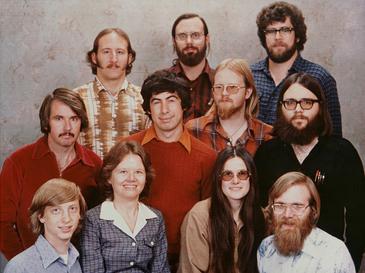
That's Paul Allen bottom right and Gates bottom left in a staff pic from 78.
Over time, by owning the operating system, the launch of Windows 95 gave them their first big entry onto the web through bundling their web browser Internet Explorer free, with the operating system. And so became the "browser wars" and the rest, as they say, is history. Ultimately gaining the accolade of 'The Evil Empire'.
Of course, an extraordinary company built by terrific people.
5 years ago, Microsoft reported profits of 6.5 billion usd.
This year they've just reported profits of 6.4 billion usd in the same quarter.
So they're still making money - but making less - although it's still a stunning amount of money.
At the same time 5 years ago, Apple reported profits of 1 billion usd.
This year, Apple reported 13 billion in profit comparably.
What is clear is that Apple has practically wiped out Microsoft as a consumer technology brand with Microsoft now having to focus on its buiness division to bring in the revenue. It has also been played out of the mobile space, where it once controlled 35% of the market.
Apples iphone business alone is bigger than all of Microsofts businesses, combined.
So ask yourself why?
What has caused this change?
It's simple and obvious but so well forgotten - Apple put the consumer first. By identifying the consumer need they then built the technology to satisfy that need.
Not the other way round.
And then be clear about what you stand for and understand your core values.
This video is inspiring and full of lessons for marketeers.
The commercial at the top of this blog is the one which Jobs just referred to in this video. Think different (1997 Chiat Day).
So the story here is clear.
You think like a consumer.
You think of consumer needs and you fulfil them.
You do so in a clear easy-to-understand way and you are 100% clear on your proposition.
Then the marketing job becomes easy.
It's why Apple has wiped the eye of Microsoft.
It's why the next Gates, Allen, Woz, Jobs will do the same.
Building software, hardware, Apps, Blogs, Social sites and all, will only achieve success, if they're meaningfully providing a solution to a real consumer need (which Pinterest is a clear example of how to do that).
We can all learn from Microsoft and Apple.
They got it first.
Think Different but think Customer. First.
Tuesday, 24 April 2012
Social Media. Jump in, cash in.
A little while ago I blogged as to whether we were seeing the signs of a bubble, similar to the one which pre-dated the 2000 crash
http://streamabout.blogspot.com/2012/04/billion-or-bubble.html
A couple of reasons prompted me to ponder that.
Firstly I was there in March of 2000 with an IPO for an ISP and it just "felt" the same. It had the same "feeling". Hardly science but if it looks like a duck, walks like a duck.....and I'm not the only one feeling that.
Secondly of course, Facebook had just acquired Instagram for a billion which seemed (and seems) to be twice Instagram's own excessive valuation a week previously. And it's a lot of cash even for something as cool as Instagram.
Thirdly, and perhaps most importantly, the Instagram acquisition came from a sucession of quick acquisitions of companies with low revenues, low staff and light track records. This to me marks out a bubble. A high level of investment interest in something that's not sparkling now but which will. Something that has belief.
By quick, I mean that only days before, Mashable, which is a blog (yes, I know it's a really good blog) but a blog nonetheless, had just sold to CNN for 200m usd. Around the same time, Draw Something, an App only weeks old had just sold to Zynga for circa 200m usd. Then most recently, Apple had achieved a valuation (market cap) of 600 billion usd. And so on.
At the same time I was noting on forums for venture Capitalists/Investors that war chests were being built. Money was being raised.
Big news then today from the UK that "Vodafone, one of Europe’s biggest mobile operators, has made a formal offer to buy up the assets of Cable & Wireless Worldwide for £1 billion ($1.7 billion), a deal that catapults Vodafone into running its own fixed line network in the UK and specifically will give it a much bigger view to winning enterprise business — a big challenge to BT and a mark of further consolidation in the space" (Techcrunch). This brings Vodafone over 10 billion usd in revenue and it's an 'agreed' bid.
Another 1.7billion usd deal.
Add to that data based start-up Locu, has raised 4m usd; Moat, an adtech start-up raised 12m usd; Answers.com, who raised 127m usd last year, announced a "significant minority stake"; Tango, a video chat service (not unlike Skype), closed a road of 40m usd in funding.
And that's just this week.
Finally just if you remain unconvinced, we are even starting to see the bragging rights of investors.....Andreesen Horowitz proudly revealing that it made $78 million off its $250,000 seed investment in Instagram’s billion-dollar acquisition (which is pretty unpalatable actually in a recession reeling world).
If this is a bubble, it's one great big opportunity.
It will bring higher valuations and potentially competitive exits. More money for Social Media investment, more money for marketing, more money to engage.
If ever there was a time to get online, develop Social Media ideas, bring new thinking to the Web, it's now.
There's money out there and more of it coming.
Monday, 23 April 2012
Apple, E-Books and the Steve Jobs Secret deal.
"Eroding the value of perception of their products in customer's minds" said Steve Jobs about the Amazon Kindle launch when they began discounting top titles to 9.99 usd. So he went about fixing it and here's the story.
I consume books, I don't just read them, I eat them. Probably three a week and I have a lot, an awful lot, in dust jackets lining shelves. Nearly as many as I now have on my Kindle.
Because I loved books and bookstores, I was one of the first to dislike The Sony EReader when it launched and yet, one of the first to adopt it because I'm in that space.
Interesting isn't it, that Sony were one of the very first companies to get into book etailing given their ongoing demise as I blogged recently here http://streamabout.blogspot.com/2012/04/sony-64billion-loss-and-death-of-brands.html. They actually had THE opportunity to own this market.
The principle was the same as itunes. Once you buy the device, you had to log into the service to download and activate. So you automatically were forced to become a book customer by just purchasing the hardware (indeed exactly the same subsequently, as Amazon's Kindle). But it guaranteed the device maker (Sony) revenue from ongoing book sales. The profit was not in the device, it was in the subsequent ecommerce book downloads and indeed, looking back they should have given the device away for free. Like shaving - the real money is in the blades not the razor.
Anyway, the Sony ereader, although first out of the box to market, was poor. Hard to operate, hard to understand, no real "store" with insufficient titles and after a day trying to operate it, I put it aside in a drawer, where it remains today untouched and unused. And then I was given an Amazon Kindle.
Actually when you think about it, Jeff Bezo's Amazon (the world's biggest bookstore) must have looked on at the time of the Sony launch with real concern which probably gave impetus to their first Kindle device. Here was a big player, Sony, entering their online space. So they had to get their device out there quickly and being rushed, did so as a basic model with few features (it's basically a black and white screen and nothing else).
But supported by a bookstore like Amazon, the Kindle quickly moved to push aside everything in its wake and achieved an unbelievable 90% market share and ultimately selling more ebooks than books themselves.
And mine changed the way I bought books forever - a fantastic little device that I adore to this day.
Recently near where I live (Dalkey, Dublin) a beautiful little book shop closed after 30 years. Run by Michael, I went up on closing day to shake his hand and thank him for the memories - but on reflection of course, us downloaders must take some responsibility for these closures. Ebooks have destroyed retail sellers like 'Waterstones' and the wonderful 'Borders', but mind you, these retailers also let this online business get past them. Exactly as so many brands still are.
The Kindle has also revolutionised price, bringing down the cost of books. The Kindle Fire, in my view, is a further example of Amazon's ambition to sell more than books and notably VOD (movies /video on demand). In reducing prices, through reducing margins (such as retailer margins) it "upset" the market but was good for consumers.
Publishers had always controlled publishing, pricing and distribution. Now they had a total change on their hands through the Kindle which actually allows authors direct access to publishing/distribution online. Great actually that the internet has broken that stranglehold too. But they didn't like it. And neither did Steve Jobs.
So in walks Apple. Late to the party but with a hugely popular device/s already out there (Iphone, Ipad) which could easily become book ereaders and in turn give Apple access to the market and compete with Kindle under a brand called 'ibooks'.
During that time (2008/9) Apple had meetings with certain publishers - because in order to become a major online book reseller, you need the content, the books, from the publishers. So you need the publishers "onside".
These meetings (actually more dinners than meetings included none other than Steve Jobs himself) took place in swanky restaurants such as New York's 'Picholine' and 'Alto' (per 'The Financial Times') with 5 of what is known as "the big 6" worldwide publishers.
What has been suggested and last week the subject of court filings, is that these meetings were in fact an attempt by Apple to collude with publishers over ebook prices (per 'The Daily Telegraph').
Publishers would enter into new agreements, called 'Agency models' with Apple, where the publisher could dictate the price of an ebook, provided the retailer (Apple ibooks) got 30% of the price. Not only would that fix prices, but drive them up for the consumer through collusion. And in doing so, give The Amazon Kindle real (unfair) competition.
Of course Apple gained by having the publishers support (so ibooks now had content) and it gave the publishers, in conjunction with Apple, an opportunity to re-establish old margins which had been squeezed as Amazon forced prices down.
Real greed, real old-world manipulation of Dickens and Thomas Hardy if it's proved to be true.
In three days in January 2010, on the eve of The Ipad launch the 5 publishers signed these "Agency agreements" with Apple (HarperCollins, Schuster, Hachette, Penguin and Pearson).
The charges that have now been filed against Apple and the publishers were immediately denied by Apple who said the "charges were simply not true". Fighting talk, however we then discover 3 of the 5 publishers, whilst admitting no guilt, immediately moved to settle. They claim innocence whilst at the same time make payments as if they were guilty. Interesting concept.
Interesting too that this weekend 'The Daily Telegraph' reports that Apple (remember, "simply not true") has offered to settle the matter in Europe but vowing to "fight on" in the USA. The European Union had opened an investigation into anti-competitive behaviour by Apple last December.
In fact Apple now is trying to turn the PR towards the fact they they were simply trying to "break", Amazon's "monopolistic grip". Indeed they were.....by what is alleged, collusion in their own interest and to the harm of consumers by increasing prices.
The fact remains that through their cries of innocence, they're trying to settle matters, as are their collusion publishers, for using price fixing as a way to further their business to the detriment of readers like me. And I hate to say that because I always thought of them as being great.
People often say and are interested in the future of Apple after Steve Jobs and wonder how it will be? They often say, such as after the recent IPad launches that "it wouldn't happen if Steve was there". Sad that in this case, he was.
What a pity that the great reputation of Apple has become tainted in this way. And yet how great it is to see more books being sold than ever, through the advent of ereaders because of low cost and ease of access.
We can thank Amazon and their Kindle for that.
Apple's "Agency Models" would have had the opposite affect.
Go out and get yourself a Kindle.
Friday, 20 April 2012
LinkedIn has a competitor. BranchOut.
I use Linkedin. I like Linkedin. But I'm getting tired of it.
Tired of long lists of updates and little interaction.
Tired of being constantly told about other people joining new groups.
Tired of a lack of interesting posting and usage.
Although there's no doubt, it is THE Business network where you can actually do business and reach out to business customers. Because largely, it's the one most established and not, if I might suggest, because of its excellence in design.
But it has become very closed as a network - introductions are not made easy - and very commercial through constant advertising. It feels very impersonal and quite limited in content. No video "hangouts", no streaming, limited news feeds and just kind of basic functionality.
So now it has a competitor - BranchOut.
It's something that Businesspeople should be aware of.
BranchOut allows users to see which of their Facebook friends (or their friends) work at specific companies and it doesn't require users to build a network one person at a time. Unlike Linkedin. And I think that's a key because the slow, time-consuming nature of building a Linkedin network, is unhelpful.
In lots of ways the profile data is similar and with a recruitment section - RecruiterConnect, (which caused Linkedin to block Branchout from using its API), it fulfills all the things that Linkedin does. And more.
With 13 million monthly unique users, BranchOut is getting more popular as a Facebook App, than Pinterest and Skype whilst still being considered a new "start up". And largely due to early adopters in the mobile space, outside of the US.
I think this is important in that there does seem to be an opportunity in the Business network/Social media space to target Linkedin. Which, it seems to me, has lost its way to a degree.
The Business market online, has real growth potential as more and more business people consider online as a place to be. Perhaps too, Linkedin users may feel it's time to move on.
BranchOut is the first of the competitors.
Just in at 230pm as an update from Business Insider. BranchOut raises 25million usd today: http://www.businessinsider.com/hey-linkedin-youd-better-go-buy-branchout-before-facebook-does-2012-4
Wednesday, 18 April 2012
Sony. The 6.4billion loss and the death of brands.
Most of us will remember Sony as the great, quality premium brand of growing up. Clever advertising instilling a real sense of long-lasting, up-to-the-minute products that were a little more expensive but hey, worth every penny. Innovation through The Walkman, Playstation, Bravia, Vaio, Cameras.....
I remember walking into The Sony Store in New York and being mesmerised by the high technology future on display. It wasn't a shop, it was a glimpse into an enthralling future and it became almost a tourist attraction.
And then most of us recently will have seen Sony spend the last 5 years tearing that image down and re-positioned as the general, competitively priced brand. Just the same as everyone else.
Except having developed the persona of "premium", make the mistake of trying to create it more around "value". People knew the brand and it's hard to move from a long-term embedded positioning to something else without losing customers.
Last week Sony flagged a 6.4billion usd annual loss and an axing of 10,000 jobs. It has of course been hammered by Apple and Samsung. It's stock has almost halved in a year.
It also emerged that The Playstation 3 was being sold at a hardware loss in the hope of recouping revenue on the games themselves.
What has happened here is typical of old-world brands.
They firstly ignore the web, then they actively rubbish it and then the web, takes them apart.
Look at what itunes has done to HMV which at one time, had that music business in its hands. Look at what Netflix is doing to retailers such as Xtravision and Blockbusters. Look at the way online gaming has hurt the 'Game' chain of stores. Look at what Amazon/E-Books have done to high street book retailing with 'Chapters' and 'Waterstones' a perfect example of that. Look at the former dominance of 'Golden Pages' compared to Google. Look at Smartphone development and what that has done to Nokia (with a company valuation falling from 100 billion to 11 billion, and quickly). What online publishing (Huffington Post a classic example) has done to Press. It goes on and on.
All of these older businesses had the brand values, the trust, had the customer loyalty, had the business knowledge and yet they got stuffed. In a lot of cases too, because they were run by middle-aged men who had/have no comprehension of what is going on. And still don't. Because they believed they were too big to fail.
The internet is the greatest brand-leveller. Its beauty is that it allows young turks with heads full of great ideas to go and eat established brands lunch. Because they've nothing to fear.
And it's not over. Not even nearly.
Recent news last week from Tesco (a brand I worked on) where they're re-shaping by reducing larger stores to focus more online, is yet another sign. Less and less people will be prepared to park in a car park on their free Saturday to do grocery shopping - they'll do it online. Which in turn means the "anchor" tenant of old in a Mall, such as the likes of Tesco, will lose impact and other retailers, whom depend on the high traffic they bring in, will suffer.
What too,is voip going to do to telephony? And are O2 (another brand I worked on) and Vodafone in a place where they're ready with a serious online strategy? Well? Didn't notice it just yet.
They should note that bigger brands have fallen and Sony's losses, typifies it. This is a big lesson.
Brands don't need banner ads. They don't need a Social Media strategy. They need an online plan.
It starts with that and re-designing your website to make it "e commerce enabled" isn't one. It needs a total radical overhaul of thinking provided by people who know and not by existing management in the main.
The excellent Sarah Gordon in the Financial Times says it as "Investors in today's technology titans such as Apple, would do well to remember just how easy it is to lose such a reputation".
I remember walking into The Sony Store in New York and being mesmerised by the high technology future on display. It wasn't a shop, it was a glimpse into an enthralling future and it became almost a tourist attraction.
And then most of us recently will have seen Sony spend the last 5 years tearing that image down and re-positioned as the general, competitively priced brand. Just the same as everyone else.
Except having developed the persona of "premium", make the mistake of trying to create it more around "value". People knew the brand and it's hard to move from a long-term embedded positioning to something else without losing customers.
Last week Sony flagged a 6.4billion usd annual loss and an axing of 10,000 jobs. It has of course been hammered by Apple and Samsung. It's stock has almost halved in a year.
It also emerged that The Playstation 3 was being sold at a hardware loss in the hope of recouping revenue on the games themselves.
What has happened here is typical of old-world brands.
They firstly ignore the web, then they actively rubbish it and then the web, takes them apart.
Look at what itunes has done to HMV which at one time, had that music business in its hands. Look at what Netflix is doing to retailers such as Xtravision and Blockbusters. Look at the way online gaming has hurt the 'Game' chain of stores. Look at what Amazon/E-Books have done to high street book retailing with 'Chapters' and 'Waterstones' a perfect example of that. Look at the former dominance of 'Golden Pages' compared to Google. Look at Smartphone development and what that has done to Nokia (with a company valuation falling from 100 billion to 11 billion, and quickly). What online publishing (Huffington Post a classic example) has done to Press. It goes on and on.
All of these older businesses had the brand values, the trust, had the customer loyalty, had the business knowledge and yet they got stuffed. In a lot of cases too, because they were run by middle-aged men who had/have no comprehension of what is going on. And still don't. Because they believed they were too big to fail.
The internet is the greatest brand-leveller. Its beauty is that it allows young turks with heads full of great ideas to go and eat established brands lunch. Because they've nothing to fear.
And it's not over. Not even nearly.
Recent news last week from Tesco (a brand I worked on) where they're re-shaping by reducing larger stores to focus more online, is yet another sign. Less and less people will be prepared to park in a car park on their free Saturday to do grocery shopping - they'll do it online. Which in turn means the "anchor" tenant of old in a Mall, such as the likes of Tesco, will lose impact and other retailers, whom depend on the high traffic they bring in, will suffer.
What too,is voip going to do to telephony? And are O2 (another brand I worked on) and Vodafone in a place where they're ready with a serious online strategy? Well? Didn't notice it just yet.
They should note that bigger brands have fallen and Sony's losses, typifies it. This is a big lesson.
Brands don't need banner ads. They don't need a Social Media strategy. They need an online plan.
It starts with that and re-designing your website to make it "e commerce enabled" isn't one. It needs a total radical overhaul of thinking provided by people who know and not by existing management in the main.
The excellent Sarah Gordon in the Financial Times says it as "Investors in today's technology titans such as Apple, would do well to remember just how easy it is to lose such a reputation".
Otherwise when the hit comes, it will be hard.
Ask Sony.
Tuesday, 17 April 2012
Google Goggles. Apple Fiddles.
'Heads up' glasses have been around for awhile. Ask any kid who ever read a Commando comic or has seen Terminator. Fighter pilots use them with strong visual displays reducing the need to look down into a cockpit.
Now Google have ventured into the make-believe with Google glasses or Google Goggles as they're known. Not only that, it marks a venture for Google out of search, into manufacture, the preserve of companies like Apple.
Apple is the largest company in the world - 600 billion usd market cap - and this is possibly its biggest threat. Laugh you may, but when a network with the power of Google, enters device manufacture, be afraid. Very afraid.
'Mashable' reports a Google source indicating their availability in 2012 as being "unlikely" but the fact is, that similar glasses already exist at retail and therefore they may not be as far fetched as they seem. The Epson range, not so different, already retails at 699 dollars and look more like surgical glasses than fashion wear, but it's a start.
The thinking is that these will have the same functionality of your smartphone and with augmented reality, bring a lot more. So it's a smartphone replacement strategy too in glasses form. As in IPhone.
Voice commands send messages; photos taken literally on the move, are shared instantly; locations via maps with directions on hand; location of friends through geo-location services; music player with video....and so on.
Indeed, think about gaming live with the glasses on or to augment skills at work (a mechanic looking into an engine for example, can identify things better). So the applications are limitless in one sense.
Of course, Apple are the kingmakers with devices like this. They have the manufacturer edge and the trust in the brands they create but, and it's a big but, they don't have the social network - or even the network. That gives Google a massive advantage.
So why reveal all so early? Remember Steve Jobs sworn to secrecy obsession before every launch?
Google say they wanted to go early to gather feedback. I don't buy that.
Wired (what has happened to that magazine?) indicated that "it was a project rather than a reality" and Mashable "it's still more of a concept than actual project!". So I think this is publicity and perhaps a sign of intent to Apple that Google intend to enter the device space.
Yep, I agree, right now they look awful and it's highly unlikely that in their present format, you'll ever see them. Or the streets will be full of people smiling and talking to themselves.
However, there's a big play here in the form of augmented reality in a new device and glasses, is one new way to deliver content.
Imagine if this level of technology and content was embedded into your car windscreen on demand, for example? Better than any smartphone.
It's really a 'heads up' on new content delivery systems. Better than any Iphone and Apples foray into content (Apps, itunes) is device driven. Think about it. You have itunes because you had to because you have an Iphone. It started with the delivery system.
Something which other brands like Nokia, LG and others should be concerned about, if they're not already.
That's what Amazon's Kindle Fire is all about. Starts with Ebooks (their killer app) and now Movies. Shortly telephony.
And that's what the original browser wars (Netscape V Internet Explorer) were about.
If you own the delivery system, you control the content.
If Google own the delivery system using content they already control, this could be world domination.
And that's no exaggeration.
If Google own the delivery system using content they already control, this could be world domination.
And that's no exaggeration.
Monday, 16 April 2012
Avis. We try Harder. Agencies have a future thanks to Google.
If ever there was a copyline, a slogan, that was self-fulfilling, it's 'Avis. We try harder', because having said it, they have to. In other words, by being honest in saying that they're not the biggest, but they wanted to be, they knew they had to do things better from within the company. You can see that in their press treatments here which clearly tell staff and customers that the company expects more.
I was involved in a well-known campaign for Irish Rail, "we're not there yet, but we're getting there" and it fitted into a similar vein. It's a honesty that half the consumers will like, half will laugh at.
And what happens when it works? Do you go with, "Avis. We're number one. We try less hard now"? I dunno.... but it's brave and around since 1962.
The company was started in 1946 by Warren Avis but the slogan in 1962 brought the company into the superleague and was created by Bill Bernbachs Agency, DDB. Although it was a defining line for DDB also, Bernbach himself is often credited as the writer. He wasn't. It was Paula Green who is featured in these videos. The truly amazing thing of course, is that it's still the slogan, 50 years later exactly.
This campaign with Google, as part of a series which I've blogged on before (for Coke, Alka Seltzer and Volvo) is defining too in that it takes classic campaigns and brings them into the digital space. Makes them "today".
For me the Coke story is the greatest of them all but this is pretty cool too. They all are. Simply they get the creatives back into Google and see what they can do. Here's that brainstorming.
So what comes of all that is the next video although you probably already get the jist. Basically, they've developed an idea around sharing stories, which you create yourself, about Avis. It's nice. Absolutely nice.... but not stunning. Although remarkable interactivity on the software side, which should not go unnoticed, through the self-publishing of stories, however, we've all become so impressed with online that we feel nothing can surprise us!
Actually it's stunning what you can do and this idea can be used for other brands. Have a look....
So that looks like the end of the line for Project re:Brief just for now. It's been a hugely interesting and entertaining concept that in my view, has helped traditional agencies to embrace the space.
Although, it's as they say, only one part of that.
A good swift kick might help too.
(All the campaigns are within this blog by clicking on the posts on the right. Coke, Alka Seltzer and Volvo. In case you're interested. But don't miss Coke, it's great and it's here http://streamabout.blogspot.com/2012/03/ad-agencies-have-future-thanks-to.html )
Friday, 13 April 2012
Ad Agencies have a future. thanks to Google. Alka Seltzer.
This is another part of an ongoing campaign by Google to "re-create" classic advertising campaigns from bygone years by bringing them into the digital age. It also does a great job for Google in showcasing their talents.
I've never seen Google as anything more than a glorified Yellow Pages with a Pool table in Reception and frankly, I think this series brings them right out of that into more of an online partner/medium.
Their efforts re-creating The "I'd like to buy the world a Coke", Coke story is terrific and if you haven't seen it, you'll get it here
http://streamabout.blogspot.com/2012/03/ad-agencies-have-future-thanks-to.html and really worth a look, I think.
The next up was for Volvo, "Drive it like you hate it" campaign and you'll see that here too http://streamabout.blogspot.com/2012/03/google-show-ad-agencies-have-future-if.html
The third is now for a classic Alka Seltzer campaign from the US in 1972. Although I get it, I never thought it had the greatness of "Plop, plop, fizz, fizz" but it was hugely successful.
Here is the original commercial.
So what Google did was to re-unite the original creative partnership of copywriter and visualiser (art director if you like) and involved them in making the concept work online.
Here's the video as to how they went about and, regrettably, it's not as riveting as the others but you have to watch it to understand the last video, which is worth watching. Still....
So you get the drift. I think what made this interesting is that way in which they decided to execute the idea. Basically the concept is to show stories about what happened before he got indigestion - not a bad idea because it becomes engaging. Stories do that and when they're streamed to new devices, they take on a new life.
Not bad. Not earth shattering.
But the manner in which it was executed on mobile particularly is pretty damn smart. Interactive and relevant.
So this is now well worth viewing. Amazing in what can be done today.
In some ways this shows the development of mobile too as a platform.
There's no doubt it can be effective, interesting and entertaining.
More than that, it can bring classic advertising into today.
Better than that, it can actually be the platform for classic advertising, created today.
I've never seen Google as anything more than a glorified Yellow Pages with a Pool table in Reception and frankly, I think this series brings them right out of that into more of an online partner/medium.
Their efforts re-creating The "I'd like to buy the world a Coke", Coke story is terrific and if you haven't seen it, you'll get it here
http://streamabout.blogspot.com/2012/03/ad-agencies-have-future-thanks-to.html and really worth a look, I think.
The next up was for Volvo, "Drive it like you hate it" campaign and you'll see that here too http://streamabout.blogspot.com/2012/03/google-show-ad-agencies-have-future-if.html
The third is now for a classic Alka Seltzer campaign from the US in 1972. Although I get it, I never thought it had the greatness of "Plop, plop, fizz, fizz" but it was hugely successful.
Here is the original commercial.
So what Google did was to re-unite the original creative partnership of copywriter and visualiser (art director if you like) and involved them in making the concept work online.
Here's the video as to how they went about and, regrettably, it's not as riveting as the others but you have to watch it to understand the last video, which is worth watching. Still....
So you get the drift. I think what made this interesting is that way in which they decided to execute the idea. Basically the concept is to show stories about what happened before he got indigestion - not a bad idea because it becomes engaging. Stories do that and when they're streamed to new devices, they take on a new life.
Not bad. Not earth shattering.
But the manner in which it was executed on mobile particularly is pretty damn smart. Interactive and relevant.
So this is now well worth viewing. Amazing in what can be done today.
In some ways this shows the development of mobile too as a platform.
There's no doubt it can be effective, interesting and entertaining.
More than that, it can bring classic advertising into today.
Better than that, it can actually be the platform for classic advertising, created today.
Thursday, 12 April 2012
You must read this. The truth of business.
This is Paul Healy. Never heard of him? Me neither until I picked up 'Business Plus' magazine in Dublin in March (a magazine that I had a tiny involvement in helping at the start for Nick Mulcahy and Siobhan O'Connell and recommend to you). Now I want to meet Paul - and I will.
I never re-publish someone else's work. Never. But I was so taken by this story that I asked Nick + Siobhan would they mind if I blogged it and kindly they allowed me to to. So why am I?
Because Paul's story is so true and real that I think everyone in business should read it and try to understand. It's absolutely heart felt and wonderful for those of us who have been start-ups or who want to be. I have - and every bit of it is me too. I know the pain and the joy. One day you're worth 30 million, 12 months later, you can't afford the petrol.
Read it. You'll be joyed by it.
Here's Nick Mulcahy's intro and it's followed by Paul's own words;
Remember swapping football stickers and cards in the schoolyard? The practice has died a death with the Xbox generation, but Paul Healy, a former
tech journalist, is looking to bring it into the 21st century with the launch
of his new startup, Fantom.
Fantom is an online trading cards game aimed at teenagers. Users buy credits with their mobile phones, which can then be used to buy trading cards across a number of themes such as music, sport, TV, fashion and film.
Healy explains: “We generate random cards. Users buy a pack of them and try and collect a full set. Any duplicates they have they can integrate with the online community on the site and social media to trade them with other users.” The firm has signed several licensing deals with companies such as the Impact Wrestling group and Concept Cars.
Healy was managing director and a shareholder in recruitment firm JobFinder, which was sold to Stepstone in 2000 for €10m. He made a bundle from that deal but a startup he embarked on in 2008 went nowhere. He hit upon the
idea for Fantom when he saw his daughter playing the online dress-up game for girls, Stardoll, which is based around the paper doll concept.
Healy says: “Stardoll has over 120 million registrations and it employs 200 people in Stockholm. I realised there was no equivalent for young boys. There's a global opportunity for us.”
Healy, 49, took the idea to the Ryan Academy Propeller accelerator programme. The academy invested €30,000 for a 6.5% equity stake,
providing free office space for three months and mentoring. Development
work started on the Fantom site in the summer of 2011 and the business
launched in January 2012 after securing outside investment. Healy’s
vision has been backed by €600,000 from the AIB Seed Capital Fund, the
Dublin Business Innovation Centre, Bloom Private Equity, Enterprise Ireland and private investor Kevin Neary, founder of Gamestop.
But the journey from concept to trading platform wasn’t easy. Some weeks, Healy was so short of cash that he had to tap his mum for a loan to feed the kids. In what follows, this dogged entrepreneur reflects in his own words on that journey and the stress and strain he and his family had to endure to get over the line.
Now Paul's story....
"The day the wall fell down was a day for taking stock. Not the Berlin wall, mind. The wall in question was my garden wall, which I found on the
pavement upon returning home from a business trip to Scotland on a chilly, dark November evening. Indoors, there was a funny smell from the fridge, which had gone on the blink, the washing machine had given up, and the transmission warning light on the car suggested nothing good was going to come of it.
Question to self: “How much more of this can I endure?”
Endurance is a required characteristic of the entrepreneur. Most who attempt to make a living through risk and initiative endure continual setback before one of their schemes goes well. Unfortunately, as I have learned, they also inflict that pain on those around them.
Did you know that we Irish coined the term ‘entrepreneur’? Wikipedia attributes the word to the Irish-French economist Richard Cantillon, who died in 1734. Tellingly, Cantillon made his fortune on a bubble, the Mississippi bubble of 1719, and, as Wikipedia writes, “his success came at a cost to his debtors, who pursued him with lawsuits, criminal charges, and even murder plots until his death”.
My flirtation with risk and initiative began in 2008. A self-employed internet project manager and trainer, I started the year optimistically, predicting annual revenue of €80,000. I stayed on track until May and then did not make a single euro in the following seven months. I was the proverbial canary in the mine for the recession.
When your livelihood disappears and you have five children, giving up is not an option. With hindsight, what fascinates me is that I chose to do what I did. One of my clients offered me the chance to weather the recession with a job in the €60k range plus benefits. Instead, I started a company and rolled the dice.
Once upon a time, I was briefly almost a millionaire. It was May 2000 and I was a small shareholder in the phenomenal dotcom cash-out of the Irish website JobFinder.ie. As we pulled away from A&L Goodbody, in whose offices we had done the deed, a colleague rang Frank Keane Motors in Blackrock and ordered a BMW 3 Series Coupe, with leather upholstery, air con, winter pack, alloys and low-profile tyres. He then turned to me and asked: “What about you?”
Since I had personally taken €750,000 in the deal, I said, without missing a beat: “Stick one of those on for me as well.”
Back home, my wife quickly reminded me that we lived in rented accommodation and the kids needed new shoes, that half of the deal was in stock (which rose, catapulting me into millionaire status, and then went to shit), and that there were some serious taxes owing on the rest.
Next morning I called the dealer and cancelled the car. But that was a sweet moment that I have always wanted to repeat.
I remember calling my mother to tell her that I was a millionaire, which was a bit of a stretch, but hey. All my adult life she had failed to understand what I did for a living, but she understood “millionaire”.
“That’s great son,” she replied, putting her hand over the phone and telling her house guests what I’d said. I could hear them in the background, clucking: “That’s nice. A millionaire! What is it he does again?”
Ten years later I was borrowing money from my mum to keep going, causing her to joke: “I am going to change my will. I will tell everyone that I loved them, and as for the money, talk to Paul; he has spent it all.”
My new business in 2008 was creating social media software targeted at niches. We tried it in politics, first with the European elections, then tracking
politicians’ output as iCitizen. Great idea, average software, poor business. There is a business tenet that runs ‘fail fast, fail cheap’. It took us 18 months to face up to what we knew early on: selling to politicians wasn’t a business.
By October 2010 I had faced the fact that I didn’t have a viable product. True to type, I rolled the dice again. We pitched the DCU Ryan Academy and were accepted onto its new Propeller accelerator scheme: €30,000 investment, three months’ mentoring and free office space. A year ago, Propeller was the only investment money in Dublin prepared to back ideas as opposed to business plans. I told them that I could create an application that monetised the social media of celebrities and they bit on it.
I shipped up to Propeller in February 2011 with my team, a fancy marketing presentation, and a question: “Now what are we going to do?” Three months later we had a product concept, a business plan and a chance. But the money was gone. As you pursue your ambition, the darker side of entrepreneurship emerges. Risk-taking becomes recklessness, endurance becomes obstinacy, and those wellhoned motivational skills verge on manipulation as you take people with you to places they had no intention of ever going. The price is paid in quality of life, asset-stripping, poor health, and the removal of basic supports from family and team members.
Through 2010 and 2011, my family, who has been accustomed to the
trappings of South Dublin boom-time living, survived on my income of
€25,000 a year and a part-time teaching income from my now ex-wife. The fat goes first: Sky Sports, the gym membership, the weekends away, meals out. And then you get stuck into the muscle: the health insurance, the life assurance, the weekly food shop, the car.
I sold my car to a Polish lad who was joining the exodus home. In fact, I
practically gave it to him, for €100. I recall last April going to do a radio
interview for Dublin South FM in Dundrum Town Centre in a borrowed banger and not even having the money to pay for parking. To make the interview, I parked the car in the driveway of someone who was likely to be at work and sneaked off.
Most people reading that will think I mean I had no change in my pocket on the day. But in fact some weeks I literally had no money in my pocket, in my bank or in the credit union. To my shame, several times in the past year I have phoned my 76-year-old mother to say:
“Mum, I cannot feed the children tonight.” She would then move €30 into
my account by telephone banking. It was during these painful times that the garden wall fell down.
In investment circles, they call this, euphemistically, the ‘three Fs round’, in which friends, family and fools support you as you struggle to turn an idea into a product and a product into a business. I don’t know about fools, but the family has been incredible, particularly the women in my life: my partner, my mother, my sisters and even my ex-wife, all of them determined to keep me buoyed up with their support and their money.
The Propellor programme gave us the opportunity to flesh out the concept for Fantom, an online trading cards game aimed at teenagers. The next step was the seed-funding round, looking for professional investors to back a business plan, with no product and a six-month cash burn to get to trading. It started inauspiciously, in a dark Georgian scullery in Fitzwilliam Place, with no money to pay the bills at the end of June.
We did the rounds but the seed funds were dismissive of accelerator companies, citing a perceived massive gap between their expectations and where we were at.
Outwardly we were putting on our best face, but back in the office we were struggling financially, buoyed up only by a personal loan from a friend. I found that Enterprise Ireland were amazing. Our development advisor basically told us to ‘man up’, to stop begging for grants and to get a serious business plan into the seed funds.
The search for investment lasted six months and during the negotiations we continued the product build, while cutting everything in our lives past the muscle to the bone. We had a joke in the office called ‘Employee of the Month’, where one lucky person got to take the pile of Dublin bus refunds down to O’Connell Street and keep the total. On several occasions we walked to work, not even having the bus fare.
A spiky conversation with a prospective seed fund investor changed the game. “I’d suggest you go to London and come back to me in September,” he said. “Then I’ll ask you who you know. If you know nobody then we’ll know it was going nowhere. If you come back connected, we can talk.” Although I never got back to this individual, I took his advice and moved to London in July, rented a desk in Shoreditch at £10 a day and lifted the phone.
London was transformative after the Dublin gloom; it was a positive, open
and business-friendly experience. By September I had licence deals, reseller understandings and connections with key people in the brand licensing community. It took another four months to close our funding round. But the tone of the investor conversations in Dublin warmed, so it was easier to keep the team together as everyone started to believe they would eat by Christmas.
Finally, on December 19, we closed our deal and delivered on our product
development commitments. Now it is time to turn a product into a business. But that’s another story.
When I look back, I liken entrepreneurship to taking a run at a cliff and daring yourself to go over. And when I ask myself how far would I go, I know now that I would go over the edge, expecting to grasp a few roots on the way down, to land on a ledge, or even, should I hit the ground, to bounce.
That’s not necessarily the point of view of a rational human being."
Extraordinary. And so real. Trust me.
Keep driving on.
Subscribe to:
Posts (Atom)