Monday, 14 October 2013
The Trouble with TV.
The role of "Television" or "Broadcasting" is changing and indeed, those terms need new definitions. No longer should we think of "Television" being the sole domain of "Television stations".
After all, consumers are now watching content in a variety of different ways. It's these changes in distribution, that's the core issue.
Whether we watch content through a traditional TV set currently, it's more likely that viewers will be watching via a connected device such as Xbox or the very excellent, Apple TV next. Indeed, the myriad of choices offered by Apple TV alone, encourages viewers to watch other content than traditional TV broadcasts. It brings a lot of movie sites, YouTube channels and Social Media into the livingroom, which in turn, brings consumers massive choice. Apple TV, for a low investment, is just stunning.
Where there's global choice of content, there's likely to be less viewing of domestic traditional TV "broadcasts" and the major US networks continue to lose audiences.
Social Media is also getting in on the act.
Twitter is trying to close the gap by becoming more involved in traditional TV through real-time conversation. Mind you, a tweet yesterday from Twitter UK saying "great to see the Xfactor bringing audiences closer and turning up the show's social soundtrack" was instantly slammed by users. Twitter are trying to become friends of the TV industry and it will fail.
Twitter wants to be the 'TV Social network' that helps build audiences which in turn, means bigger audiences for Twitter. Indeed, they're showing 60 second Ads during TV shows on Twitter as an "add on" to the programming and encouraging advertisers to sync their advertising. Take a spot at a particular time on the traditional TV show and sync it with one on Twitter.
In my view, they've tied their colours to the wrong mast.
What connected "broadcasting" devices are bringing is choice and choice that may come without Ads (such as the current online DVD boxset "binge"). A choice that means you never miss the start, the end, or forget to record a programme because online content is not hamstrung by TV schedules.
In the online world you get content, when you want it, rather than when a broadcaster decides to push it out. That is the main structural problem with traditional TV - Scheduling....rather than viewing freedom. And it's a difficult problem for TV stations to deal with, being so ingrained in their culture.
Of course too, content makers (which includes traditional TV stations) have to get used to a new model, where they're prepared to give out that content to other networks, with the copyright/royalty issues that come with that. But they will in effect, become content providers rather than "broadcasters".
BBC are starting on this path allowing 30 days access to content rather than a week, announced last week. Moreover, they'll allow some content to be viewed online before it has been traditionally broadcast. That's the sort of thinking required.
The development of "live" programming (notably Sports) is going to be interesting too. At the moment, few online channels, outside of traditional TV stations, have shown an interest in providing live content because of both cost and technology issues. But they might buy it in.
The difficulty with "TV" is that distribution has changed and will change completely. If TV stations are to survive it, they have to be prepared to change their model and few, it seems to me, are. They'd rather rubbish the online experience in the hope that it will go away, which it won't. And whilst they take the seat of Nero, everything changes around them, quickly.
Netflix develop original, exclusive content (winning Emmy's for their content such as 'House of Cards') but they're not the only ones as Amazon and Hulu now do the same. Big budgets too, so their content is real TV competition.
Binge viewing is driving online as well, as all the content of a particular show (the full series for example) is available same day. No longer do you have to wait for weeks to get to the ending. Movie releases are following suit with some Studios releasing Movies online first.
YouTube channels are developing at pace allowing ordinary content providers (be they members of the public or production companies) opportunities to broadcast. Awesomeness TV, a children's channel, now has a staggering 60 million viewers a month on YouTube. One YouTube gaming channel has 251 million. So these YouTube viewers have to be watching less traditional TV.
Social Media such as Twitter and Facebook are venturing into the space albeit in a collaborative way, for now. But they will develop their own content in time with News content being their initial entry.
Without any doubt, traditional TV has to change and become more online enabled and involved. Rebroadcasting of today's programmes via an App or online, doesn't cut it. It requires a complete re-think about how they create content, how they broadcast it and how they need to ditch their scheduling.
Perhaps too, they have to re brand and realise that their future lies not on what they broadcast on TV sets, but rather through their website. It's their website that's king and critically, how that content is being made available. To prioritise the web over traditional, will require in traditional broadcasters, a massive mindset shift.
All in all, it may be too late.....and in the eyes of this writer, it probably is because there is no sign of any dawn of realisation.
None.
It's gone past time to fight it.
Thursday, 10 October 2013
Newspaper Paywalls. The Sports Illustrated Experiment. And perhaps a better one.
There's a lot of talk in Newspaper circles about paywalls.
Leaky paywalls, full paywalls and basically any paywall way of generating revenue from the news and content they provide.
It is ridiculous when you think about it, that we all expect our news to be free, when it is probably the most expensive content to produce. But we do, because it's always been like that.
And the whole problem is bolstered by a decline in Newspaper printed cover prices as people opt to get their free news online. It's not that they're consuming less news, they're just choosing to get it for free.
So not only is online not generating revenue, but it reduces revenue from print cover prices, as people switch to the "free" version. An Age old discussion, I know. But what happens in effect, is that Newspapers develop excellent online sites to actually damage themselves. There's no choice....or is there?
A problem too, is that if one title in a local market, introduces a paywall and their competitors don't, then they will lose their readers to the competitor's free version. No doubt. So either everyone introduces a paywall same day, or nobody can.
However, when you have a "free" online newspaper or magazine, there is some benefit in generating money from the substantial traffic that follows, through advertising.
Typically banner advertising, page take-overs and pre-rolls on video. At the minute, that advertising does not come close to compensating for the provision of the service. Nor is it ever likely to
If on the other hand, you introduce a paywall, and provide content only to those who pay for it, then that general traffic dramatically decreases, literally overnight, as people switch to other free sites. Hence any chance you had of generating those Ad dollars, disappears.
The San Fran Chronicle recently dropped their paywall for this very reason.
It's a huge quandary but .....there may be answers.
One is and an interesting one, to see US magazine 'Sports Illustrated' try something different. They're testing a paywall that allows users access to all of its content for free, IF readers watch a 30 second video Ad first.
Watch the Ad, you get the content "free" for 24 hours. Then you need to watch another video ad for another 24 hours free.
Not unlike the way TV stations force you to watch video ads before their online programmes - sometimes 7 videos!
The view on Sports Illustrated to date, is that 70% of readers will watch the video Ad to get to the content. Forbes have been doing something similar for ages too.
Because too, those Sports Illustrated (or indeed Forbes.com) readers, are so well targeted (the demographic is clear), Sports Illustrated sell the video ads at a premium.
So they still have the traffic (because the content is ultimately free inside) for advertisers, albeit with a drop-off in readers (-30%). And they now have a new Advertising stream in forcing readers to watch the video ad.
Good experiment, well worth a look and if it works, it could be one answer to the prayers of online newspapers.
However, there is another, which I've been saying for a long time and spoken to Newspaper CEO's about. And which probably needs another Blog in its own right but it's a thought......
If you have 40 or 50 million views (impressions) a month, it doesn't really matter why they are there really, what matters is, that they are.
In essence, you have a consumer market to sell into. Ready made Shopping Mall.
And so the answer might be to turn the Newspaper into a shop.
When you read a story about a Sports match - let customers buy tickets, buy merchandise etc there and then via a clickthru. When you read a piece about a book, a play, a movie etc let readers buy tickets. When you read Fashion, Beauty, even some breaking news, let readers buy. That's the new revenue stream and therefore, you'd actually want encourage free readers with more free content. The more readers you have, the more shoppers to sell to.
Coupled with the Advertising revenue that's already there, it could be the trick.
And even better still, when you have an Ad in the online edition, don't charge advertisers for traditional space, charge them for results. Change the Ad model.
Don't sell a Car manufacturer an "Ad", sell them test drives (which was probably the purpose of the Ad in the first place!).
Don't sell a pharmacy a page take over rate, sell them customers and take a percentage.
After all, that's what Advertisers want - Results.
And that's what readers want - free content.
And that's what online Newspapers have - millions of consumers with the potential to generate real money from them.
With 50 million consumers a month, some Irish Newspapers could be the biggest Shopping Sites in Europe.
Wednesday, 9 October 2013
Digital Radio rolls out globally. iTunes Radio has real potential to own this.
Without a doubt, the next wave is going to be Digital Radio.
We have music streaming services on monthly subscription and we have music downloads, now we'll have sophisticated digital radio with more than 250 DJ curated stations to listen to - for free.
And Apple will own it.
They launched the service in September (same day as IOS7 so it got little PR) across all devices including Apple TV, but only in the USA, for now. Already they're announcing plans to roll it out across Europe. UK, NZ, Australia and Canada were announced only yesterday.
It features in the Itunes store and thereby, immediately putting it in front of an audience of millions. 11 million listeners tried it in the first 5 days after launch.....
What it does in part, is to build pre-made stations around your music choices. So if you hear a particularly song you like, it will tell you the stations that have just played it. Therefore, they might be your kind of stations.
Or you might just want stations that play your favourite genre - Country, Jazz - it will bring you those. The more you listen, the more personalised your station becomes as you decide to make choices - for example, 'never play that song again' - and it won't. The more you listen, the more itunes knows the stations you love and the more it can play the music you love.
So you create your own station in effect, or a pre-made one created based on music you listen to or the music you buy. But there are text and audio ads built into the music and hence it's free although you can remove Ads by upgrading through a subscription. It already has Ad deals in place with P&G, McDonalds, Pepsi and Nissan to start.
It looks too like there's no streaming limits so in some ways it's head-to-head with 13 year old Pandora (Apple are beating them in their quick roll-out and music rights buy-outs) and Spotify, although different.
Pandora may suffer and reports are that Pandora customers are switching over. However, Bloggers are critical of Apple for simply "copying Pandora". Something Steve Jobs was so critical of other brands doing to Apple.
Of course too, by listening to ITunes Radio, if you hear a song or artist you like, you can buy it there and then.
So it's encouraging music sales by giving listeners what are, free samples. Clever.
And without any doubt, Apple have the distribution, the brand, the financial clout to own Digital Radio globally. Which will have implications for traditional, local stations especially in a young, 14-26 demographic. Those radio stations will need to wake-up to this challenge and they can, by having one big advantage - local content.
Certainly in Ireland, Radio Media owners tend to be smart, bright people but the sudden impact of an Itunes Radio launch will require a response. Now's the time to formulate that because it's coming.
Be 100% sure of that.
Tuesday, 8 October 2013
Twitter IPO. Looks like November 8th trading day.
Twitter's IPO is probably the most awaited floatation since Facebook.
Although still loss-making and small, it is growing and has revenues of 448 million usd in the last year, twice that of LinkedIn when it floated two years ago. LinkedIn then, was valued then at 4 billion usd (now it's 27 billion usd) and Twitter IPO expectations have been between 10-15 billion usd. Facebook we will all sorely remember, peaked at 100 million usd.
Twitter will shortly begin their investor roadshow and The FT have reported that a first day of trading is likely to be November 8th. Of course, they'll need to convince investors first, that they've turned a corner and will be showing greater future profitability. Twitter's revenues largely come from US traffic although it only accounts for 23% of Twitter usage, so reaching out globally, will be key. It needs its advertising to be better engaged outside of the US.
What Twitter needs to do is to instill confidence that it can generate good solid money in the longer term through advertising and avoid the hyped webby valuations. Facebook lessons still hang in the air and it's fair to assume that this IPO will be more measured, more considered.
Notwithstanding that, Twitter has a big following as being a good all round Social Media player with longevity. It's less "flash in the pan" and more down to earth with its potential for profit, still largely, unproven.
But all of these IPO's get the market's blood rushing. It's an opportunity for Wall Street to turn a profit quickly on "Mom's and Pop's" shares. So we will see their hype rather than Twitters. So be warned of pre-IPO publicity.
But, it's probably a good buy because getting on board now, in a reasonable IPO, reminds one a little of Apple founders.
What Twitter does is good and growing.
That's the fundamental.
Monday, 7 October 2013
Instagram to roll out Ads. Enjoy it whilst it's Ad free.
Instagram, the photo/video sharing site, is officially to start rolling out Ads in the US slowly. Video Ads are to come mid 2014 whilst at the moment, Instagram is "ad free".
Instagram is the site where you can use some very cool filters on your pics that makes them look beautiful.....and they work. Owned by Facebook (acquired 2012 for nearly a billion usd), with a guesstimate of 150 million active users, the "Ads" will largely be quality brand photos placed in your feed, whether you follow them or not. But they won't be 'banners'.
However, Instagram are indicating that you'll have some control over what you Ads you see. So they have concerns about the disruption that advertising can cause, especially on a quality site like this. A lot of brands do have already a great presence on Instagram with high followers. Notably fashion brands such as Burberry.
The contextual relevance of Ads is key and in order to deliver effectively on that, data will become key. When signing up for Instagram, that data is fairly basic so that could become the issue for targeting unless they cross-correlate with Facebook usage.
Without the ability to 'click thru' too, it's likely Instagram will just be selling impressions.
Celebs have already actively made sponsored posts for brands such as Nike, without Instagram earning a cent. Although such posts are now required to feature a disclaimer if they're commercial.
Instagram needs to become a stand-alone business and "monetize" (hate that word) its users. Advertising is one way to do that. However, it will be interesting to watch how they strike that balance between annoying people and generating revenue.
Their owner Facebook, is not exactly strapped for cash, so they'll go at it slowly as they've said, with experiment after experiment until they get it right. If not, they may risk their business.
More likely is that they'll get it right and it'll be a good model for other sites too.
Friday, 4 October 2013
Microsoft CEO Steve Ballmer says goodbye emotionally and with his favourite song. And it's not, "On the good ship, Lollipop".
'Crazy' Steve Ballmer, the food of many a blog and mine included, departs Microsoft as CEO. He says goodbye to 13,000 Microsoft employees in Seattle after 13 years at the helm but 33 years at the business.
'Crazy' because of his style of presentation and if you search him on this blog, you'll get the drift. This goodbye one, is actually tame in comparison.
Fairly emotionally he says it too and it's hard not to feel for the man. Despite it all, it's a tear jerker until that is, he ends with a song. A song of his choosing that says it all up for him. His favourite song.
Jennifer Warnes "Time of my life" from 'Dirty Dancing'. Jesus. But that kind of sums him up.
Wonder what Movie song will Bill Gates choose when he goes? Answers on a postcard but I'm guessing..... "Working 9 to 5".
Thursday, 3 October 2013
Coke. A real good example of a story well told using online video. Terrific.
Not a big fan of Coke (which is like giving a compliment with one hand and taking it away with the other) because of the high level of sugar which damages kids. There's an average of 11 cubes of sugar in a can of Coke.
But I am a big fan of the type of activity that Coke have done to market themselves. Like the surprise of spreading a little happiness on a grey day as the video shows. It's a great little idea.
What's more too, is the video production which is super, although I don't know who made it.
It gets across the spirit of the day using gentle cutaways of people being happy in an almost 'secret filming' way and yet it tells the story of the greenery being rolled out. Like every good online video, it should have a start, a middle and an end.
The music track is ideal and certainly feels "commissioned" rather than stock library music. It builds brilliantly.
The reveal of the bottle shape at the end leaves something for the viewer coupled with a lovely end graphic which was not cheap to do, I can tell you.
So a great story, well told.
And a great story to "share" as I am doing with you, which is the whole point of video. Nearly 60,000 personal up close views, in 2 days. That's real one-to-one marketing.
So it's a classic example of online video doing a great job for Coke. Exactly the way video was intended to be used. Little bit of trouble, little bit of thinking and you get something that's viewable and shareable.
Good for Coke. Pass it on.
Wednesday, 2 October 2013
Delta Airlines 11,000 pilots to get Microsoft Surface tablets instead of flight bags. Ad Campaign crying out to be done....
Delta Airlines have announced that they're to replace Pilot's flight bags with Surface 2 Tablets. That's 11,000 of an order for Microsoft Surface where Pilots will now board without the iconic, but 35 pound heavy, flight kit.
The saving in weight is one good reason as well as reducing paper (and therefore, CO2) but flying lighter saves fuel, saves money. Also, one would think that it's more efficient and that the tablet will have better, up-to-the-minute graphics and information such as weather detail.
The Microsoft Surface has had a poor first year - 900m usd in write downs and a price slash to attract customers and only about 1.5 million Surface tablets sold. How many Ipads sold in the same period you ask? About 60 million.
So there was some surprise at Delta's decision to opt for the Microsoft Surface. However, it does bring Microsoft a gift in marketing terms, if they're smart to it. A whole Ad campaign about what tablet do pilots trust? After all, your life might depend on it....that sort of thing.
The Tablet that's trusted because it's reliable; it works under all conditions; it's accurate; it's light - all the stuff that a pilot might need it for.
An Ad campaign crying out to be done.
Hello? Anybody?
Tuesday, 1 October 2013
YouTube Music Awards November 3rd. They're killing Television.
If ever you wanted an example where digital broadcasting is eating into traditional Television, here's one.
YouTube have designed the 'YouTube music awards' on November 3rd, a lovely idea in itself because of their younger profile and the fact that music is a such a big YouTube driver. A lot of stars would never have got a music deal (such as Psy) were it not for exposure on YouTube.
However, the show which features Lady Gaga, Eminem, Arcade Fire and loads of other top acts, will be broadcast live.....on eh,YouTube. The 90 minute show will be driven by awards from votes and data about viewership on YouTube.
YouTube will also be showcasing contending artists in the build-up. And some of those artists will not be hugely well known generally but big on YouTube.
But this will be bigger than MTV.
So here is a digital channel that's generating its own awards that it will broadcast itself. So no need for traditional TV there at all and in fact, they're being left out in the cold as they won't have the content. They won't be able to broadcast the show.
So when they tell you TV viewing is growing, be careful out there.
Cause it sure won't be on November 3rd amongst that younger audience who'll be glued to YouTube.
YouTube and exclusive content on Netflix are killing Television.
This is only the start.
Friday, 27 September 2013
Breaking Bad ends Sunday. Here's a viral to remind you of the best bits. The most rated TV show ever.
The final, all-time last episode (called 'Felina), of Breaking Bad ends on Sunday. The photo above has just been released by the studio taken from the last episode.
Netflix expect to have it within 24 hours of the live broadcast.
It's been called the greatest TV series ever and certainly set the record as the world's most rated show ever. It has also driven Social Media in that it got a massive surge online being given a perfect '10' online.
Believe me, people are crazy about it and I've blogged about it before on September 18th below.
The penultimate episode had 6.6 million viewers live.
Mind you, it reportedly cost 3 million usd per episode, to make.
So this YouTube viral is outtakes and emotional scenes which for fans, should be enjoyable.
By the way, Walt dies. Maybe not.
Wednesday, 25 September 2013
Twitter's moving into Advertising by broadcasting 30 second TV spots.
Twitter is moving more into advertising notably in advance of its IPO.
If Twitter can show real ways to generate revenue (current 2013 revenues expected at circa 500 million usd, a doubling of last year) it will help their float.
One way they're doing it, and talking to Ad Agencies about it, is to introduce the standard 30 second TV spot. They've been present at Adweek this week in NYC, a big traditional advertising get-together.
What they're suggesting is that advertisers broadcast their 30 second spot in the Twitter feeds of anyone watching the programme live online. So the ad would appear on TV as usual but also on second screens twitter feeds, simultaneously. Lovely idea.
It shows Twitter as an ally of TV which is a good move. TV Broadcasters could do the same in reverse.
With 200m active users sending 400m tweets a day, Twitter has been behind the door regarding advertising. But now, money counts especially in convincing investors of big revenue potential. A lot of Ad Agencies view Twitter as a Social Media tool rather than a medium in its own right. A lot of traditional Ad Agencies mind you, view everything Social as being tools.
Twitter have an Ad strategy that in my view, works.
But advertisers will find the money from their traditional TV budgets.
Tuesday, 24 September 2013
Flipboard raises 50 million Dollars. Value of 800 million. And it deserves it all.
My all-time favourite App?
Flipboard and it's not an App, it's a thing of beauty, allowing you to merge and mash all your feeds into one "designery" space. This is top end design with relevant content that's really going upwards.
They've just announced they've raised 50 million us Dollars in funding, bringing the company valuation to about 800 million usd.
Founded only in 2010 by Mike McCue, they have 85 million registered users which surprises me that it's so low....
Almost like a top-end magazine it aggregates news feeds with social media in the way you want it as "flippable" pages. It also allows you consequently, to create your own magazine and over a million have done that including 'Rolling Stone' and 'National Geographic'. That's a self-publishing dream.
But the long term play for Flipboard I think anyway, is deciding on what content to include and by that I mean, getting revenues from publishers who want to be included. If you own the App, you decide on what goes in.
With 85 million users it hasn't reached the critical mass of say, Twitter (800 million)....yet. But when it does, it will be a real player that it deserves to be. It wasn't that long ago (a year?) that they had 20 million users.
They've also gently started ECommerce with a 'click to buy' button working on a sales margin. That's going to be big.
It's the sort of news innovation coupled with top rate design and functionality, that is leading the way (although the current digital issue of 'Wired', is also something to behold).
And if you haven't got it, get it now.
Flipboard are getting the financial recognition at last.
Monday, 23 September 2013
Blackberry sells today. 4.7 Billion Dollars. OMG.
So Wow, they were able to sell Blackberry..for a 9 dollar a share price bringing in 4.7 billion us dollars. Extraordinary.
The buyer is Fairfax financial, a Canadian Insurance fund (Blackberry is Canadian too) who were also Blackberry's largest shareholder. Blackberry was, Canada's greatest star.
It has come after a weekend of speculation, notably by the excellent UK 'Telegraph', when Blackberry announced losses of almost 1 billion usd in Q2 and planned to slash 4,500 jobs with shares slumping by -24% on Friday last.
Shares were trading at circa 8 dollars and I remember them at 138 dollars.
It had officially put itself up for sale last month having hired PWC to help.
Amazon and Microsoft had considered buying it previously but Microsoft's Nokia deal put paid to that. The BBM (Blackberry messaging service) is the golden egg with 60 million users although the once dominant company has really struggled against Apple, HTC and Samsung since 2007.
Blackberry once controlled half of the US market (!), now that's under 3%.
The BBM service had one great advantage - as London rioters and drug dealers knew - it was hard to intercept. Hence it became popular with drug sellers and became known as 'Crackberry'.
It only shipped 2.7m of its latest Z10 phones out of a planned 6.8m although it sold 5.9m smartphones in Q2, well below expectations. Apple, for example, sold 37m and the Iphone 5S sold out online.... in 5 minutes.
Blackberry had slashed phone prices so effectively, they couldn't give them away. Its losses reflected a big write-down on this stock of unsold phones.
The story of the downfall of Blackberry (if you call a sale of billions a downfall) is that they stuck with a corporate market and a keyboard, largely ignoring connectivity to the internet as having value. When they realised their mistake, it was too little, too late.
Keyboards had their day, internet connectivity was king and the corporate market became a personal market. Executives choose their own phone for business and personal use, rather than a company bought phone.
It's a sad story in one way but ultimately a good story in that they've done well to attain a good price now. Or lucky to have a shareholder like Fairfax, prepared to protect their investment and obviously being cash-rich enough to do so.
Still. A once dominant brand like Nokia, bit the dust. Or has it?
Friday, 20 September 2013
Grand Theft Auto launched this week. And made 600 million Dollars profit in the first 24 hours.
They were saying that gaming had peaked....maybe it has, but Grand Theft Auto (GTA) 5, sold a whopping 800 million us dollars (that's "sell through" into retailers) in the first 24 hours after launching this week.
It has smashed records and will easily do a billion this year. Easy.
Call of Duty (Black Ops 2) only sold a shameful 500 million in their first 24 hour sell. Imagine the disappointment.
Retailers this week across the world, opened their doors at midnight to sell GTA and very reminiscent of Microsoft launches of old (remember them?).
Unlike other games - Call of Duty and Assassin's Creed are annual updates - GTA hasn't been out in 5 years building excitement. It's also being raved about.
The availability of online access has driven this growth creating further opportunities for revenue from game owners through interactive upgrades etc. So GTA's sim crime, is a real winner. Although it's controversial, in that opponents say it encourages violence.
Costing 200 million usd to make, that's a pretty fun way to make a profit for Edinburgh based developer, 'Rockstar'. Although a lot of employers reporting staff going sick on the launch day....
Terrific story really from a British crew facing a global business.
Edinburgh? Beautiful, but hardly silicone valley.
See? It can be done.
Wednesday, 18 September 2013
Breaking Bad. It's officially the greatest rated TV show of all time. This week's episode was the "best TV episode ever made". Why?
The greatest rated TV show of all time. Officially.
If one more person tells me 'Breaking Bad' is the best thing on television - ever! - I'll scream. And note the word Television.
Everyone in Streamabout, who have a good eye for this sort of thing, are crazy about it, especially cameramen. Obsessive even.
I watched 4 episodes, Series 1 and it lost me but unquestionably, I'm in a tiny, tiny minority.
The show was created by Vince Gilligan for Sony Pictures, having previously written The X Files.
This week's episode "Ozymandias" (episode 14, series 5... in case you're asked because fans talk like that) got a huge, perfect '10' from 12,000 reviewers on Amazon's IMDb. Which makes it into Television history. Nothing else has come close to that online reaction.
Critics went ecstatic and fans were left breathless. An OMG! reaction. The name, Ozymandias, is from a famous sonnet by Shelley about a crumbling empire.
It has been talked about as being one of the best TV episodes "ever made". I kid you not.
Set in New Mexico, the show premiered in January 2008 about a chemistry teacher who turns bad (or good some say?). This final ever series completes (a total of 62 episodes) on September 29th and Netflix has really helped to grow the audience and is the greatest rated TV show of all time in The Guinness Book of Records.
I won't list the awards it has won, because it's just too long.
But what Breaking Bad does show is that good drama, good content still works on Television and Online. It also shows that Social Media engagement in content, is more and more critical.
When 12,000 online reviewers give it a '10', it makes you think that you have to watch it and so spreads the word, virally. Good shows get noticed quicker and get audiences faster, rather than the 'hit and miss' of old because of online recommendation.
After all, it's the oldest cornerstone of advertising - word of mouth - and Social Media gives you that in droves. So Breaking Bad shows what can be done with traditional TV content, broadcasting online and Social Media engagement.
So I for one am going back to it, to see what the fuss is all about.
Or Chemistry.
Yeah, I hear there's money in that?
Tuesday, 17 September 2013
Amazon Instant Video gets Airplay Support on Apple TV. This changes things. Again.
Amazon instant video has now got fully updated with Airplay support on Apple TV.
What does that mean?
It means you can use their App to watch Prime Instant Video and The Amazon Instant Video store on your Apple TV. Like Netflix, it's a big upgrade for their competitor as Apple (who may control connected TV's) have reached a deal with Amazon.
It also allows full integration with Amazon's IMDb which you might be familiar with and which also gives information on movie casts, soundtrack, history etc. In turn that allows them to offer you a Movie by the same Director? or including the same cast? So a lot more integration.
You can also have other features which traditional TV doesn't give you; like customer reviews or ratings; like "if you like this, watch this"; like concurrent downloads; like so much stuff enhancing your viewing.
The App is free and fully compatible too. Amazon, having tried to buy 'Roku' and not completing it, were rumoured to be producing their own set-top box. This may indicate that they've decided not to.
As I see it, it's a clear example of a "deal" being done between a content provider (Amazon) and a device supplier (Apple). In other words, if you want your content on a device such as Apple TV, you'll need to do a deal too.
Which will worry many because "free to air" on standard TV's, might not be a distribution route in the future simply because, standard TV's will phase out as they're replaced with Connected TV's. I suggest it's unlikely that your next TV will be a standard TV and more likely a connected one.
And if you want to "do a deal" say as a traditional content supplier, Apple will need to be convinced that they want your content firstly. And even if they do (they may not want 'home produced' features or local content for example), you can be outbid by cash rich dotcoms to keep you off.
How would Irish news for example, fit into this platform? Streamed online means moving around whilst a free App might do it? Don't know, but it will disrupt.
So this will change the world.
Because it changes distribution.
A little bit about Twitter and Jack Dorsey. And the IPO.
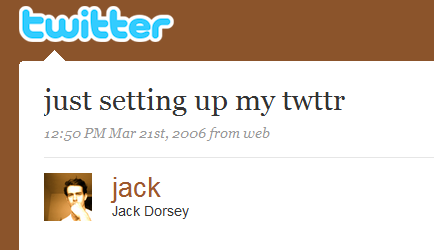
Jack Dorsey's first ever tweet.
It was July 15th 2006, when Jack Dorsey launched Twitter (although his first tweet was in March) with the now infamous 140 characters, designed by the way, so that mobile users could easily text, tweets.
He was working in San Fran at that time when he approached a podcasting Software company Odeo and whilst he was obsessed with..... Trains...and Taxis. In fact he wrote software to co-ordinate Taxi locations.
The name was inspired by Flickr and it was first used as an internal service within Odeo.
7 years later, 200 million active users (over 500m registered users though), tweet 400 million times a day. 60% of tweets are from mobiles.
Now, in advance of the impending IPO, it has a value of between 10 and 15 billion us dollars. It had revenues last year of 250 million usd although that's likely to double this year.
Over time, Dorsey was moved out of the company in 2008 and following equity calls, had his stake diluted to just over 3% and he started to develop payments company, Square. That's worth over 3 billion us dollars today.
Twitter is now one of the 10 most visited websites and Justin Bieber the most popular on Twitter with over 44m followers. Obama is the highest politician and FC Barcelona, the highest followed sports club.
Dorsey was born in 1976 in St. Louis, raised a Catholic and Forbes put his net worth at over a billion usd. With a forearm length tattoo and a drop out of New York University, he originally thought he wanted to be an artist.
Very interested in politics, there's been talk about him running as Mayor of New York. Real talk.
But all in all, it's a fairly admirable story. Unlikely that Jack Dorsey will make a complete fortune from the Twitter IPO given his stake, he will always be seen as the founder of Twitter.
And if you're not on it, get there.
It's absolutely an obsession.
Oh, it's @stuartfogarty btw.
Monday, 16 September 2013
Newspapers are embracing digital. And The Independent Group are making a fine job of it too.
In the digital age, one of the media that's often quoted as being in the firing line is newspapers. And they have been, but that doesn't mean that they're sitting on their hands and rolling over because they're not. They're actually embracing it and making a damn good job of it too with The Independent Group really making inroads.
What online and video brings to publishers, is the ability to sell TV commercials and the ability to use their established brands with loyal readers, to develop interactive magazines (IMags). Streamabout have been playing a role in delivering these quality videos for online publishers.
Clearly, firstly, the use of video news, allows for pre-roll and mid-roll advertising which allows newspapers to broadcast TV Commercials - something they've never been able to do before. In fact it's an opportunity for newspapers to attract in large TV advertisers whom they've never had as clients before. Who'd ever have thought you'd seen a 30 second TV commercial in a newspaper?
Newspapers can now scale up into the lucrative TV airtime space and that's a whole lot of opportunity for new revenue. Because TV Advertising as a sector, generally dominates media revenues.
Pre-rolls are now developed, available and growing with great long term potential.
The second offering of interactive magazines is a further development of that space. Here the online edition of a magazine - what is normally a printed product in tandem, although one wonders if IMags will become standalone opportunities - gives further, better interactive content.
The Irish/Sunday Independent have been at the forefront of this. Their online imagazine 'Juno' published yesterday, is a clear example of that.
A succession of interactive magazines aimed at niches such as Rugby ('Lineout'), Childcare ('Mothers&Babies'), Fitness ('Fit'), Exams, GAA, Christmas ('Mistletoe'), Soccer ('Soccer Legends') and so on, has been more than a foot in the water. In fact, when you look at the list, you'll see the pro-activity.
You'll find them all linked on www.independent.ie homepage, under 'Services' as you may not be able to click the links in this blog. (If you can't, just cut+paste the links here into your browser). But I've included two videos here at the end which are well worth the watch - honestly!
Yesterday, they published a lifestyle magazine, 'Juno' edited by Constance Harris, with The Sunday Independent but also online.
http://supplements.independent.ie/?xml=Juno_iMag&iid=80896#folio=1
For example, whilst the printed version featured a fashion shoot with legendary photographer Mike Bunn, the interactive magazine had 3 'behind the scenes' videos about the shoots. So readers were able to delve into it more and understand what it's like to shoot fashion.
http://supplements.independent.ie/?xml=Juno_iMag&iid=80896#folio=30
A piece with model Roz Purcell on a lingerie shoot, also came with a video (calm down) where interviews with the photographer, stylist and scenes from the shoot were very watchable.
http://supplements.independent.ie/?xml=Juno_iMag&iid=80896#folio=46
A story about Irish female authors self-publishing their work, allowed for online interviews with the actual authors.
http://supplements.independent.ie/?xml=Juno_iMag&iid=80896#folio=26
Another fashion shoot meant online, you saw it in the making plus more detail on the garments.
http://supplements.independent.ie/?xml=Juno_iMag&iid=80896#folio=62
Another video was able to give you tips on how the make up was applied by a top make up artist from the shoot.
http://supplements.independent.ie/?xml=Juno_iMag&iid=80896#folio=76
A story on wellbeing with Karen Ward, gave your more insight on her interactive video interview.
http://supplements.independent.ie/?xml=Juno_iMag&iid=80896#folio=82
All supported by brands like Chanel, L'Oreal, Clarins, BT's, Newbridge and so on, who introduced their own TV Commercials, links directly to their websites facilitating purchase and links to their Social Media pages.
With all the content available to freely share on Social Media.
So digital now brings publishing and magazines to life and gives the readers further content to view for free. With the expertise of editorial that's available to a topline publisher like the Irish Independent and Sunday Independent, they're assured of being quality and will be hard to beat.
A clear example of embracing digital.
And INM are doing it very, very well.
Have a look at this one from yesterdays 'Juno'. The story of a first. A Fashion Shoot in deepest Ireland, on a 'rock' called Skellig with legendary photographer, Mike Bunn.
Oh okay then, here's the Roz Purcell one from 'Juno' too.
Friday, 13 September 2013
TV Audiences versus Online viewing. You know which one is winning and growing, don't you.
You do get tired of a constant barrage of PR and in essence propaganda, from vested interest groups in the TV market, telling us that TV viewing is growing. In fact, it's getting better they say. TV viewing?
They've not learnt the lessons of the music industry, nor the book publishing industry, that instead of knocking digital, they can embrace it and make from it. Digital can be the saviour of TV as CBS are finding out.
Tired and weary.
Sure, I have a vested interest in online video but I don't hide behind it, and I have a daily vested interest in Advertising. Traditional TV broadcasters do hide, producing Press Releases and Research under acronyms as "facts". And the reason I'm interested in online, as a former dyed in the wool Adman, is that I know it's where the eyeballs are heading. I still do traditional Advertising but I tell clients the truth.
TV stations are of course, afraid of online and video online viewership, so they have to keep telling a yarn that the online explosion isn't really happening, when it is. Understandable perhaps, but it's helping, as intended, to dampen advertising support online. Which is slowing online growth - but not for long.
However, advertisers are cleverer than that because they know the switch in audience away from traditional TV - simply from their own experience. Anyone with a child under 18, sees it everyday.
It might surprise some, but Clients are people too.
It's a simple fact that as Social Networks have grown, people are spending more time (notably in the traditional peak time evening viewing) on those networks. And if they're doing that, they're consuming less TV OR, watching it differently by second screens. Second screens clearly reduce the impact of advertising. It's just commonsense.
Online video is soaring.
- 58% of the US stream (EMarketer) up from 20% in three years.
- 75% of internet users are watching digital video (EMarketer).
- 87% of people complete a video ad (that's from Nielsen)
- "internet video ads have a higher impact than TV Ads" (that's Nielsen too).
- "TV viewing is flat, steamers are watching more online video for longer" (IAB)
- And digital is growing in that light 18-34 hard to reach TV audience (Nielsen).
- Light TV viewers are shifting online quicker (Nielsen).
- 145 million people in the US watch video online compared to 290 million who watch TV. And that was in 2012 (Mashable)
- YouTube has over 1 billion viewers a month (Daily Mail) and "more 18-34's watch YouTube than any cable TV channel".
- Online video advertising is expected to grow +40% this year (Business Insider)
- Americans aged 12-34 are spending less time in front of their TV's (New York Times)
- Netflix now has 33 million subscribers (that's paid for viewers who are more valuable to advertisers).
- "Households abandon cable and Satellite TV for streaming" (Forbes).
Will I go on?
The point too, is that all the opposing arguments are based on data - nobody is lying - but it's how you interpret that data for your own PR purposes is the issue. As someone said, if 40% of car accidents are by drunk drivers, then sober drivers are more dangerous.
It's not the data - it's how you use it.
So a word to media planners and buyers. A word to marketing managers and brand managers. A word to Admen. Use your commonsense.
TV isn't dead....but it's dying.
You know it and so do I.
Do you think you'll ever buy a TV again? You won't, you'll buy a connected TV for online content which in a lot of cases, simply won't show traditional TV programmes. If you own the device (like Apple will own Apple TV), you'll own the content and that's broadcasters biggest fear - distribution. It could close them.
You pay to get on the App Store. You'll pay for access to connected TV as a content provider IF they want your content. And they probably won't.
Look at data and ask yourself why it has been given to you.
Question it.
Time for a change.
Wednesday, 11 September 2013
12 years today.
Twelve years ago today, 2,606 lost their lives in the buildings. Hard to believe still. And nothing more to say. Except this.
The new Freedom Tower at The WTC (above), will be completed this year.
Bigger, Better and Stronger.
Tuesday, 10 September 2013
The Steve Jobs firing from Apple by his best friend, John Sculley, in 1985. John Sculley video talks about it this week for the first time.....and Jobs about Sculley "he destroyed everything, starting with me"
Steve Jobs recruited John Sculley from President at Pepsi (which he had joined in 1963) on the infamous quote that did Sculley want to sell sugar water all his life, or join Jobs and change the world? Sculley had been famous for developing 'The Pepsi Challenge' 1975 taste-test campaign.
That was 1983 and they became best friends describing it as an "amazing partnership". In 1984, there was the famous Superbowl commercial, "1984" (ironically).
Eventually Jobs believed Sculley was "bad for Apple" and a power struggle culminated in a Board showdown in May 1985. Having been best friends, they were now best enemies.
The Board sided with Sculley and 5 months later, Jobs resigned from Apple. Of course in 1986 he started Pixar and in 1995 produced their first feature, 'Toy Story'. Jobs was the Executive Producer.
In 1996 Jobs rejoined Apple and the rest, as they say, is history. Sculley had left/fired in 1993.
It's pretty clear that the clash was between an innovator and a business head. Sculley was focused on structure, cashflow and traditional business whilst Jobs was just an unruly doer. Jobs, it has to be said, was no angel either.
And Sculley has never talked about it...until this week aged 74. Worth a look.
And then at the very,very end of this piece - hear Jobs talking about Sculley - "I hired the wrong guy.....he destroyed everything I'd spent 10 years working for...starting with me"
Monday, 9 September 2013
Instagram shows unreal growth for Facebook. 150 million active monthly users. Their video offering is driving it.
When Facebook bought Instagram (an App) for a billion usd in April of last year, most of us were scratching our heads. Whilst Instagram had 9 employees (it was started in October 2010), it was the first time Facebook had acquired a business like this.
9 employees, 1 billion?? Here's my blog from then;
http://streamabout.blogspot.ie/2012/04/instagram-sells-to-facebook-today-1.html
This week, Instagram has just announced that it has 150 million active monthly users - that's 50 million more than it had 7 months ago and that is, unbelievable growth. 60% of these users are outside of the US which makes it even more appealing.
With this growth comes Ads and Instagram have said that they'll start selling ads next year and that will now go some way to repaying Facebook. With this amount of users, it won't take too long to generate a billion dollars in revenue.
One of the things that's driving this growth is Instagram online video which started a few months back. So you can not just view pretty pictures but pretty video too.
Fairly extraordinary stuff and one where I think we can safely admit....it looks like we were wrong....online video driving growth, again. I should have known.
Subscribe to:
Posts (Atom)